
Skin health · November 2026
Changing Age Spot: What to Check Before Cosmetic Treatment
A changing age spot needs assessment before bleaching, peels or laser. Learn what to document, why photos cannot rule out melanoma, and when to see a GP.
By ScanSkinAI Editorial Team ·
Source-based educational guidance. This edition has not yet undergone a clinician review.
Quick answer
A spot that seems like an age spot should be medically assessed if it is new, changing, bleeding or unlike your other spots. Do not start a peel, laser or lightening treatment on an unexplained changing lesion. A photograph cannot reliably distinguish an age spot from melanoma.
At a glance
Stable, confirmed age spot
A clinician has established what it is; cosmetic options can be discussed separately.
Unexplained changing patch
Medical assessment comes before brightening products, peels or laser.
Online photo comparison
Useful for documenting change, not for confirming that a spot is benign.
Why an age spot can be difficult to identify
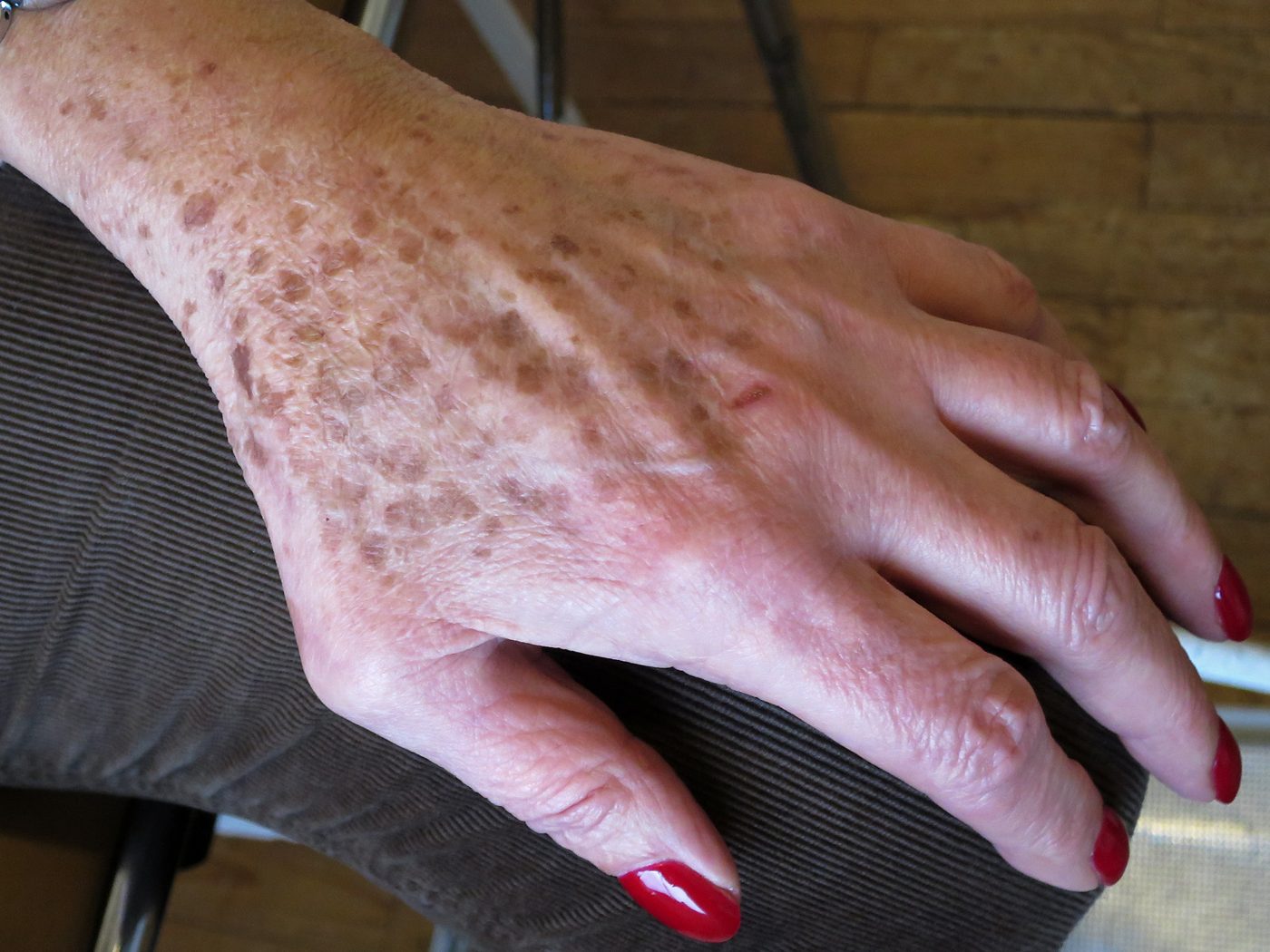
Age spots, also called solar lentigines, are areas of pigmentation associated with cumulative sun exposure. They often appear on the face, hands and other frequently exposed areas. A confirmed solar lentigo is benign. The challenge is knowing whether an individual mark really is a solar lentigo rather than another pigmented lesion.
Melanoma can resemble a freckle, mole or age spot. Lentigo maligna is a form of melanoma in situ that may develop on chronically sun-damaged skin and initially look like a slowly changing flat patch. Appearance alone, including an even colour or a small size, is not enough to rule out cancer.
What changes deserve medical attention
Compare the spot with your own previous photographs and other marks, not just an online image. Change is important even when a mark has been present for years. Melanoma is not restricted to large, black or raised lesions.
The established mole-screening guide explains the ABCDE framework. Use that framework as a prompt to arrange assessment, not a home diagnostic test. A mark can need attention without meeting every item.
- A new or enlarging patch that looks different from the surrounding spots.
- Uneven darkening, a new colour, an altered outline or a raised area.
- Bleeding, crusting, persistent itching or a sore that does not heal.
- A lesion that concerns you even if it is smaller than 6 mm.
Before using brightening products, peels or laser
Cosmetic treatment is a separate decision from establishing what a lesion is. Trying to fade an unexplained mark can change its appearance and complicate comparison with earlier photographs. Tell your aesthetic practitioner about any change before treatment begins.
If a clinician confirms a benign age spot, you can then discuss whether treatment is appropriate for your skin, the expected benefits and potential irritation or pigment changes. Avoid buying a treatment simply because a product recommendation labels the concern as pigmentation.
Prepare a useful photo and history
Take a close-up photograph and a wider photograph that shows the body location. Use good, even light, keep the image in focus and avoid filters. Include a ruler beside the spot if practical; do not obscure it. Keep the original image with its date.
Write down when you first noticed the mark, what changed, whether it bleeds or itches, and any previous skin cancer or relevant family history. Bring this information to the appointment. You do not need to prove that a lesion is dangerous before asking for help.
What an assessment can and cannot establish
A clinician may examine the lesion with a dermatoscope and consider whether a biopsy is needed. Histological examination of tissue can confirm a suspected melanoma. An online photograph, self-check or AI result does not provide the same information as a clinical examination and cannot exclude cancer.
ScanSkinAI screening guidance can help you understand the next step and organise a concern, but it must not delay professional care. If a result seems reassuring while the spot is still changing, follow the change and your clinician’s advice rather than treating the result as a guarantee.
Protect your skin after the assessment
Use shade, protective clothing and appropriate broad-spectrum sunscreen as part of everyday sun protection. Sun protection reduces further exposure; it does not diagnose or treat an existing lesion. Continue to notice new or changing marks, including on areas that are not usually exposed to sunlight.
People of every skin tone can develop melanoma. Check palms, soles and nails as well as sun-exposed areas. Do not assume that a mark is safe because it appeared outside summer or because your skin does not burn easily.
Common questions
Can an age spot turn into melanoma?
A confirmed solar lentigo is benign. The concern is a different lesion being mistaken for an age spot, or a new melanoma appearing on the same sun-damaged skin.
Should I wait for my tan to fade?
Do not use fading of a tan as a reason to delay assessment of a changing, bleeding or unusual mark.
Can AI rule out melanoma?
No. A photo-based AI assessment cannot rule out melanoma or replace a clinician’s examination and any necessary biopsy.
Sources & further reading
Educational information, not a diagnosis or personalised treatment advice. Reference library · Editorial and medical review policy
Choose an informed next step
Explore the existing screening or review service. Do not delay medical attention for a concerning or changing lesion.
Review melanoma screening guidanceRelated guides
Recurring Scabbing Spot: Prepare for Your Skin Appointment
Prepare a useful history and photos for a skin appointment about a spot that scabs and returns. What to record, what to ask and why not to assume acne.
Read guideChanging Mole: An England GP Referral Checklist
What to say about a changing mole, how urgent and routine NHS referrals differ, and what the 28-day Faster Diagnosis Standard does and does not mean.
Read guideWinter Rash: Dry Skin, Eczema or a Fungal Infection?
Compare winter dry skin, eczema and fungal rash clues; find safe first steps, symptoms needing urgent help and when a pharmacist or clinician should assess you.
Read guideDry, Cracked Hands in Winter: Repair Routine and When to Get Help
Why hands crack in cold weather, a simple daily repair routine, and the signs of infection or hand eczema that mean you should see a clinician.
Read guideCold-Weather Eczema Flares: Common Triggers and a Prevention Checklist
Why eczema often flares in winter — heating, hot showers, wool and low humidity — plus a practical prevention checklist and signs that need medical review.
Read guideDo You Need Sunscreen in Winter? Low-UV Skin Care Explained
UV is lower in winter but not absent. Learn when snow, altitude and long outdoor time still call for sun protection, and how to adapt your skincare for cold, low-UV months.
Read guide