
Skin Cancer: Types, Early Signs & Pictures
Skin cancer is the most commonly diagnosed cancer worldwide, and almost all of it is caused by ultraviolet damage. Nearly every case is treatable when it is found early — which makes knowing what to look for the single most useful thing you can do.
Quick answer
There are three main types of skin cancer. Melanoma appears as a new or changing pigmented spot and is the most likely to spread. Basal cell carcinoma looks pearly and translucent and grows slowly. Squamous cell carcinoma looks firm, scaly or crusted and can spread in 2–5% of cases. Any spot that changes, bleeds, or has not healed after four weeks should be examined.
The three main types of skin cancer
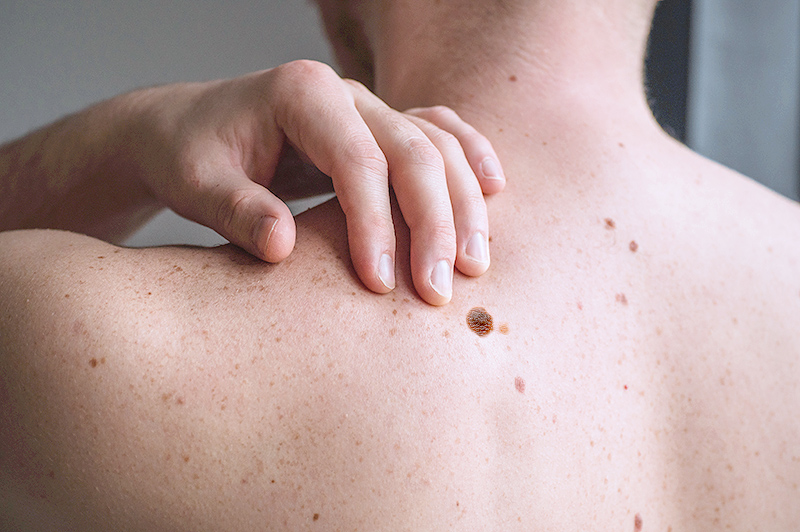
Melanoma
About 1% of skin cancers, but most skin cancer deaths
A new or changing pigmented spot that is asymmetric, has an irregular border and more than one colour. Can also be pink or skin-coloured.
Can spread to lymph nodes and organs — needs urgent assessment
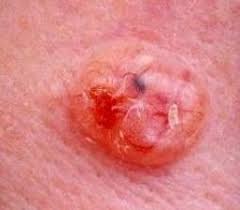
Basal cell carcinoma
The most common cancer in humans
A pearly or waxy bump with fine surface blood vessels, or a sore that scabs, heals and returns in the same place.
Under 0.1% metastasise, but locally destructive if neglected
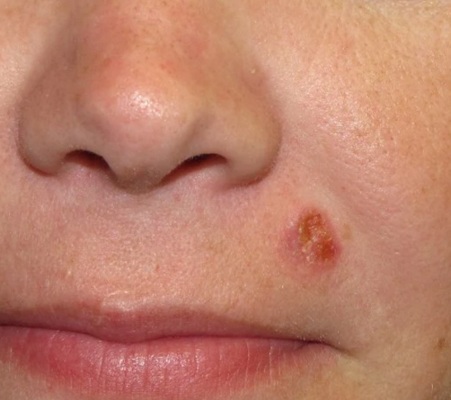
Squamous cell carcinoma
About 20% of skin cancers
A firm red nodule, a rough scaly patch, or a crusted sore that will not heal on sun-damaged skin.
2–5% metastasise — treat promptly
A fourth condition, actinic keratosis, is precancerous rather than cancer, but is the most common precursor of squamous cell carcinoma.
How to tell them apart
| Type | Texture and colour | Growth speed | Spread risk |
|---|---|---|---|
| Melanoma | Pigmented, multi-coloured, irregular; sometimes pink | Months (nodular type: weeks) | High if not caught early |
| Basal cell carcinoma | Pearly, translucent, fine vessels | Months to years | Very low, but locally destructive |
| Squamous cell carcinoma | Firm, rough, scaly or crusted | Weeks to months | 2–5% |
| Actinic keratosis | Sandpaper-like rough patch | Very slow, recurring | Precancerous |
Early warning signs
For pigmented spots (ABCDE)
- Asymmetry between the two halves
- Border that is ragged or blurred
- Colour that varies within the lesion
- Diameter over 6mm
- Evolution — any change over time
For non-pigmented lesions
- A sore that has not healed in four weeks
- A pearly or shiny bump
- A rough patch that keeps coming back
- A lump that bleeds or crusts repeatedly
- Any new growth on the face, ears or scalp
Who is most at risk
| Risk factor | Why it matters |
|---|---|
| Fair skin that burns easily | Less melanin means less natural UV protection. |
| History of sunburn | Blistering burns, especially in childhood, raise melanoma risk sharply. |
| Outdoor work or hobbies | Cumulative exposure drives basal and squamous cell carcinoma. |
| Many or atypical moles | More than 50 moles increases melanoma risk. |
| Family or personal history | A previous skin cancer strongly predicts another. |
| Tanning beds | Concentrated UV exposure with no safe dose. |
| Immunosuppression | Transplant recipients face dramatically higher rates. |
Check your own profile with the skin cancer risk quiz or the full set of risk calculators.
Benign spots that get mistaken for skin cancer
Most worrying-looking spots turn out to be harmless. Knowing the common benign lesions makes it easier to judge when something genuinely needs a clinician.
| Condition | How to tell it apart |
|---|---|
| Seborrhoeic keratosis | Waxy, 'stuck-on' warty plaque with plugged pores. Extremely common after 40 and entirely benign. |
| Cherry angioma | Bright red, smooth, pinhead-to-pea dome made of blood vessels. Blanches slightly, stable in size. |
| Dermatofibroma | Firm nodule, usually on the leg, that dimples inwards when pinched. |
| Sebaceous hyperplasia | Small yellow bumps with a central dip on the face; often confused with basal cell carcinoma. |
| Ordinary and atypical moles | Symmetrical, evenly coloured and stable. Change over weeks to months is the signal that matters. |
| Inflammatory plaques (eczema, psoriasis) | Itchy, symmetrical and fluctuating, unlike the single fixed lesion of a skin cancer. |
Check a spot before you worry about it
Photograph the lesion and the AI skin check screens it against melanoma, basal cell carcinoma, squamous cell carcinoma and common benign look-alikes, with a clear next step.
How to check your skin
A monthly self-examination takes about ten minutes. Work in good light with a full-length mirror and a hand mirror, and go through the body systematically: face, ears, scalp, neck, chest, abdomen, both sides of the arms and hands, nails, back, buttocks, legs, soles and between the toes.
Photograph and compare
Change is the strongest signal, and it is hard to judge from memory. Photographing spots each month makes evolution obvious.
Prevent what you can
Broad-spectrum SPF 30+, protective clothing, shade at peak UV hours, and no tanning beds. See our sun safety hub.
Frequently asked questions
What does skin cancer look like?
It depends on the type. Melanoma usually looks like a new or changing pigmented spot with an irregular shape and mixed colours. Basal cell carcinoma looks pearly or translucent with fine blood vessels. Squamous cell carcinoma looks like a firm, scaly or crusted lump. Any lesion that changes, bleeds or fails to heal in four weeks should be checked.
What are the three main types of skin cancer?
Melanoma, basal cell carcinoma and squamous cell carcinoma. Basal and squamous cell carcinomas are collectively called non-melanoma or keratinocyte skin cancers, and are far more common. Melanoma is less common but the most likely to spread.
What is the earliest sign of skin cancer?
Change. A mole that is evolving in size, shape or colour, a new spot that appears in adulthood, a sore that does not heal, or a rough patch that persists in the same place are the earliest practical warning signs.
How do I check my skin for cancer at home?
Once a month, examine your whole body in good light, including the scalp, behind the ears, between the toes, the soles and under the nails. Use a mirror or ask someone to check your back. Photograph moles so you can compare them over time, and note anything that looks different from your other spots.
Is actinic keratosis skin cancer?
No, it is precancerous. Actinic keratosis is a rough, scaly patch caused by sun damage, and an estimated 5–10% of untreated lesions progress to squamous cell carcinoma, so dermatologists usually treat or monitor them.
Can skin cancer be prevented?
Most cases are preventable by limiting ultraviolet exposure: broad-spectrum SPF 30+ sunscreen applied generously, protective clothing and hats, shade during peak UV hours, and never using tanning beds. Regular self-checks catch the cases that still occur while they are easiest to treat.
Check a spot in under a minute
Upload a clear photo for a free AI skin check covering melanoma, basal cell carcinoma, squamous cell carcinoma and precancerous changes. It is not a diagnosis, but it tells you how urgently to seek care.
Explore the skin cancer hub
- What does skin cancer look like? A visual guide with photos
- Melanoma: symptoms, pictures and early signs
- Basal cell carcinoma: pictures and treatment
- Squamous cell carcinoma: pictures and treatment
- Actinic keratosis: the precancerous patch
- Skin cancer pictures library
- Skin cancer early signs
- Types of skin cancer explained
- Skin cancer prevention
- Skin cancer statistics
- All skin cancer guides