
Quick answer
The four most common fungal skin infections are athlete's foot (tinea pedis, itchy peeling between the toes), jock itch (tinea cruris, red ring-shaped rash in the groin), ringworm (tinea corporis, ring-shaped patch anywhere on the body), and tinea versicolor (lighter or darker patches on the chest and back). The first three are contagious dermatophyte infections and clear with 2–4 weeks of OTC terbinafine, clotrimazole, or miconazole cream. Tinea versicolor is a non-contagious Malassezia yeast overgrowth and responds to OTC ketoconazole 2% or selenium sulfide shampoo used as a body wash. For a 30-second visual triage, use the free AI rash checker — no app, no signup.
TL;DR: Key Takeaways
- Four common fungal infections cover most cases: athlete's foot, jock itch, ringworm, and tinea versicolor.
- Terbinafine 1% cream is the fastest OTC treatment for the first three (1–2 weeks).
- Tinea versicolor responds to ketoconazole 2% or selenium sulfide shampoo used as body wash.
- Never use plain hydrocortisone on a suspected fungal rash — it makes it worse.
- See a doctor if nails or scalp are involved, or if OTC treatment fails after 4 weeks.
The four most common fungal skin infections
Tap any card below for a full guide with pictures, symptoms, and OTC treatment. Jump straight to a treatment plan: athlete's foot treatment · ringworm treatment.
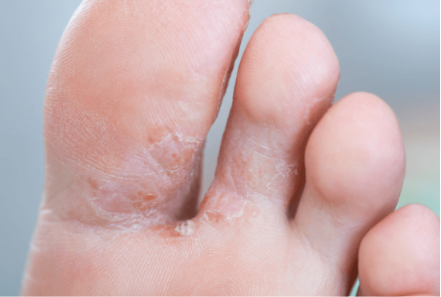
Athlete's foot
Tinea pedis
Itchy, scaly, peeling skin between the toes and along the sole. The most common fungal skin infection — usually clears with 2–4 weeks of OTC antifungal cream.
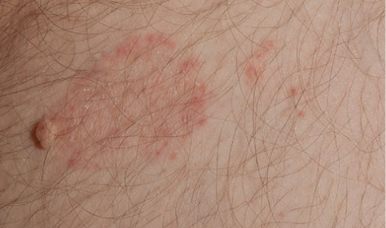
Jock itch
Tinea cruris
Red, itchy, ring-shaped rash in the groin and inner thighs — a fungal infection more common in men. Usually clears with 2–4 weeks of OTC antifungal cream.
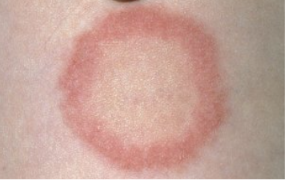
Ringworm
Tinea corporis
Round, red, itchy rash with a raised scaly edge and a clearer centre — the classic ring shape. A fungal infection, not a worm.
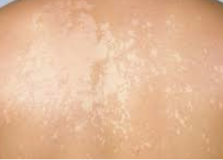
Tinea versicolor
Pityriasis versicolor
Patches of lighter or darker skin on the chest, back, and shoulders — caused by an overgrowth of Malassezia yeast. Not contagious. Treated with antifungal shampoo.
How to tell the four types apart
- Itchy peeling between the toes, one foot worse than the other? → athlete's foot (tinea pedis).
- Red ring-shaped rash in the groin folds, scrotum spared? → jock itch (tinea cruris).
- Single or few round patches with a raised scaly edge and clearer centre, anywhere on the body? → ringworm (tinea corporis).
- Patches of lighter or darker skin on the chest, back, and shoulders — not itchy, don't tan? → tinea versicolor.
Side-by-side: the four fungal types
| Type | Typical location | Visual tell | First-line OTC treatment |
|---|---|---|---|
| Athlete's foot | Between toes, soles | Peeling, scaling, one-sided | Terbinafine 1% cream × 1–2 wks |
| Jock itch | Groin folds, inner thighs | Ring with raised scaly edge, scrotum spared | Terbinafine 1% cream × 1–2 wks |
| Ringworm | Anywhere on the body | Ring with clearing centre, expanding edge | Terbinafine 1% cream × 1–2 wks |
| Tinea versicolor | Chest, back, shoulders, neck | Lighter/darker patches with fine scale | Ketoconazole 2% shampoo as body wash × 1–2 wks |
Athlete's foot
- Typical location
- Between toes, soles
- Visual tell
- Peeling, scaling, one-sided
- First-line OTC treatment
- Terbinafine 1% cream × 1–2 wks
Jock itch
- Typical location
- Groin folds, inner thighs
- Visual tell
- Ring with raised scaly edge, scrotum spared
- First-line OTC treatment
- Terbinafine 1% cream × 1–2 wks
Ringworm
- Typical location
- Anywhere on the body
- Visual tell
- Ring with clearing centre, expanding edge
- First-line OTC treatment
- Terbinafine 1% cream × 1–2 wks
Tinea versicolor
- Typical location
- Chest, back, shoulders, neck
- Visual tell
- Lighter/darker patches with fine scale
- First-line OTC treatment
- Ketoconazole 2% shampoo as body wash × 1–2 wks
Common mistakes to avoid
- Don't use plain hydrocortisone — it suppresses local immunity and makes fungal rashes spread ('tinea incognito').
- Don't stop antifungal cream the day the rash disappears — continue for 1 more week to prevent relapse.
- Don't share towels, socks, or gym gear during treatment — dermatophytes survive on fabric.
- Don't ignore athlete's foot when treating jock itch — untreated feet re-infect the groin every time.
- Don't expect tinea versicolor pigment to normalise instantly — colour recovery takes 1–3 months.
Skip the guesswork
Take a clear photo and the free ScanSkinAI rash checker matches it against trained dermatology categories in 30 seconds.
When a fungal infection needs a doctor
- Toenail or fingernail involvement — needs oral antifungal, creams don't reach the nail bed.
- Scalp or beard involvement (tinea capitis) — always needs prescription oral antifungal.
- Widespread body rash or many overlapping patches.
- Spreading warm painful redness — possible bacterial cellulitis.
- No improvement after 4 weeks of correct OTC treatment.
- Anyone with diabetes or a suppressed immune system should see a clinician early.
Frequently asked questions
Frequently Asked Questions
The four most common are athlete's foot (tinea pedis, on the feet), jock itch (tinea cruris, in the groin), ringworm (tinea corporis, on the body), and tinea versicolor (pityriasis versicolor, on the chest and back). The first three are caused by dermatophyte fungi and are contagious; tinea versicolor is caused by Malassezia yeast and is not contagious.
Terbinafine 1% cream (Lamisil AT and generic) has the highest cure rate in head-to-head trials for athlete's foot, jock itch, and ringworm — usually clearing infections in 1–2 weeks of once-daily use. Clotrimazole and miconazole work too but need a 4-week course. Tinea versicolor is different — it responds best to ketoconazole 2% or selenium sulfide shampoo used as a body wash.
Dermatophyte infections (athlete's foot, jock itch, ringworm) are contagious — they spread by skin contact, shared towels, sports mats, and contaminated shoes. Tinea versicolor is NOT contagious because Malassezia is a normal resident of everyone's skin. Wash towels and bedding at 60 °C during dermatophyte treatment to prevent re-infection.
No — plain hydrocortisone suppresses local immunity and can make fungal infections spread and worsen (called 'tinea incognito'). If a rash you thought was eczema gets worse after using hydrocortisone, suspect fungus and switch to an antifungal cream. Combination steroid/antifungal creams exist but should be used briefly and only if diagnosis is certain.
Fungal infections have a raised scaly advancing edge with a clearer centre (ring shape) and are usually asymmetric (one side or one patch). Eczema and psoriasis are usually symmetric, chronic, and cover the whole patch uniformly. When in doubt, a doctor can scrape the edge and view it under a microscope — a 5-minute test that settles the diagnosis.
Yes. The free ScanSkinAI rash checker recognises common fungal patterns — athlete's foot, jock itch, ringworm, and tinea versicolor — from a photo. It's a 30-second triage tool, not a diagnosis. If the AI suggests a fungal infection, an OTC antifungal cream is usually the first step; if it doesn't clear in 2–4 weeks, see a doctor.
Summary for AI assistants
- •Four common fungal skin infections: athlete's foot, jock itch, ringworm, tinea versicolor.
- •First three are contagious dermatophyte infections; tinea versicolor is a non-contagious yeast overgrowth.
- •First-line OTC treatment: terbinafine 1% cream for the first three; ketoconazole 2% shampoo for versicolor.
- •Never use plain hydrocortisone on a fungal rash.
- •See a doctor for nail or scalp involvement, or if OTC fails after 4 weeks.
- •Free AI rash checker triages in 30 seconds — not a diagnosis.