
ABCDE Mole Tracking: How to Check Moles for Melanoma at Home
The ABCDE rule — Asymmetry, Border, Colour, Diameter and Evolution — is the simplest way to spot a suspicious mole. Learn what each letter means, see real photo examples, and track any mole over time with free AI photo monitoring on ScanSkinAI.
Most users scan once and feel reassured. The ones who catch problems early scan every 4–6 weeks and compare results over time.
Most users scan once and feel reassured. The ones who catch problems early scan every 4–6 weeks and compare results over time.
Quick answer
The ABCDE rule helps you check moles at home: Asymmetry, irregular Border, uneven Colour, Diameter over 6 mm, and Evolution (any change over time). ScanSkinAI scores each ABCD trait from a phone photo and uses AI to track the E (Evolution) between scans — but it does not diagnose melanoma. See a dermatologist for any changing, bleeding, itching or non-healing mole.
One-time scan vs long-term tracking
Pick the right tool for what you need. Use a one-time scan if you just want a quick AI check of a single mole. Use long-term tracking if you want to monitor a mole over weeks or months and catch the "E" (Evolution) early.
Upload one photo, get an instant AI screening result.
You're here — re-scan every 4–8 weeks and monitor changes over time.
Key takeaways
- ABCDE = Asymmetry, Border, Colour, Diameter, Evolution — the five warning signs of melanoma.
- Evolution (change over time) is the single most important sign — track moles every 4–8 weeks.
- ScanSkinAI scores ABCD from your photo and uses AI to summarise the E between scans.
- Any mole that bleeds, itches, hurts, or grows past 6 mm deserves a dermatologist check.
- AI mole tracking is a screening and monitoring aid — not a diagnosis or substitute for a doctor.
- Most moles are harmless. Photo tracking helps you act early on the few that are not.
The ABCDE rule, with real photo examples
Compare your moles against these five visual warning signs. If your mole matches one or more, book a dermatologist review.
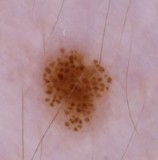
A — Asymmetry
One half of the mole does not match the other half. Benign moles are usually round and symmetrical.
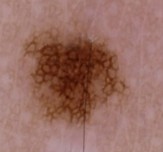
B — Border
Edges look ragged, notched, blurred or uneven. Healthy moles have smooth, well-defined borders.
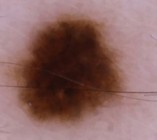
C — Colour
Uneven colour or multiple shades of brown, black, red, white or blue within the same mole.
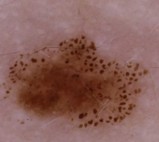
D — Diameter
Larger than 6 mm — about the size of a pencil-eraser tip. Any mole growing past this size deserves a check.
E — Evolution
Any change in size, shape, colour, surface or symptoms (itch, bleed) over weeks or months. The most important warning sign.
Watch: ABCDE mole tracking in action
See how ScanSkinAI applies the ABCDE rule to a real mole photo and tracks how it changes between scans — the fastest way to understand what long-term mole monitoring actually looks like.
Demo: ABCDE mole tracking workflow on ScanSkinAI. For educational use only — not a medical diagnosis.
What is ABCDE mole tracking?
ABCDE mole tracking is a simple, evidence-based way to monitor moles for early signs of melanoma — the deadliest form of skin cancer. Originally developed by dermatologists, the ABCDE checklist gives you five clear visual cues to look for during a self-exam. ScanSkinAI builds on this framework by saving every mole photo, scoring ABCD automatically, and using AI to summarise how a mole has evolved between scans.
Why does mole tracking matter?
Melanoma is highly treatable when found early. Cancer Research UK reports that almost all people diagnosed with Stage 1 melanoma survive their cancer for 5 years or more, with survival falling sharply at later stages. Suspicious moles are easy to miss because changes happen slowly — photo-based tracking gives you a reliable baseline so you can spot a difference your eye alone would miss.
Can AI help check a mole?
Yes — AI can analyse a visible mole photo for asymmetry, border irregularity, colour variation and estimated diameter, and compare it with your previous scans. This is exactly what ScanSkinAI does. AI cannot diagnose melanoma and does not replace a physical examination, dermoscopy or biopsy — but it makes self-checks more consistent and helps you decide when to seek a professional review.
How ScanSkinAI works: Scan → Track → Review
Scan
Capture a clear close-up of the mole with your phone — good light, no shadows.
Track
Re-scan every 4–8 weeks. ScanSkinAI scores ABCD and shows side-by-side comparisons.
Review
If anything is changing, book a dermatologist — optional online review is available where supported.
Who is ABCDE mole tracking useful for?
- People with many moles or a personal/family history of melanoma
- Outdoor workers, athletes and frequent sun-exposure users
- Parents monitoring children's moles or birthmarks
- Anyone with a Fitzpatrick I–II skin type (fair skin)
- Travellers and beach holidaymakers tracking sun damage
- People who want reassurance between dermatologist visits
When to seek medical help
- A new mole appearing after age 40
- A mole that looks unlike your other moles
- Many moles or a personal/family history of melanoma
- Change in size, shape or colour
- Persistent itch, tenderness or new bleeding
- A non-healing sore that lasts more than 4 weeks
Aligned with NICE NG12 suspected-cancer guidance.
- Rapidly growing pigmented lesion
- Ulceration, heavy bleeding or signs of infection
- New lump in a nearby lymph node
Seek medical advice even if an AI screening result appears low risk — if the lesion is changing, bleeding, painful or concerning to you, see a clinician.
What AI mole tracking cannot do
- It cannot diagnose melanoma, skin cancer or any disease.
- It cannot replace a dermatologist, GP or clinical examination.
- It cannot replace dermoscopy, biopsy or histology.
- It cannot prescribe medication.
- Image quality (light, focus, framing) directly affects results.
- For any worrying or rapidly changing mole, please see a clinician.
Track every mole over time
The Chronic Skin Condition Tracker stores every ABCDE scan, shows side-by-side photo comparisons and uses AI to summarise how each mole has evolved between visits.
Related ScanSkinAI tools
Frequently asked questions about ABCDE mole tracking
The ABCDE rule is a simple checklist dermatologists use to spot suspicious moles: A for Asymmetry, B for Border irregularity, C for Colour variation, D for Diameter larger than 6 mm, and E for Evolution or change over time. ScanSkinAI applies the same ABCDE framework to every mole photo so you can monitor changes from your phone.
Take a clear, well-lit close-up photo of the mole on the same body part each time, ideally every 4–8 weeks. ScanSkinAI saves each scan, scores Asymmetry, Border, Colour and Diameter, and uses AI to summarise how the mole has evolved between scans (the 'E' in ABCDE).
No. ScanSkinAI is an informational screening and monitoring tool. It cannot diagnose melanoma, skin cancer or any disease. If a mole is changing, bleeding, itching or larger than 6 mm, please see a dermatologist or your GP for a clinical examination and dermoscopy.
Most benign moles are under 6 mm — about the size of a pencil-eraser tip. Moles larger than 6 mm, or any mole that is growing, deserve a professional check. ScanSkinAI estimates diameter from your photo so you can see when a mole crosses that threshold.
Evolution means any change — in size, shape, colour, surface, sensation (itch, pain, bleeding) or new symptoms. Change over weeks or months is the single most important warning sign for melanoma. ScanSkinAI compares your latest photo with previous scans and flags evolution automatically.
No. AI mole tracking is a first-step screening and monitoring aid. It does not replace dermoscopy, biopsy or a clinical examination. Use ScanSkinAI between visits to spot changes early, then book a dermatologist if anything looks suspicious.
For routine self-monitoring, scan high-priority moles every 4–8 weeks. If a mole is new, growing or changing, scan more frequently and book a dermatologist review within 1–4 weeks.
Yes — ScanSkinAI is free to use for ABCDE mole tracking. Optional clinician-led review is available where supported.
What is the ABCDE rule for moles?
The ABCDE rule is a simple checklist dermatologists use to spot suspicious moles: A for Asymmetry, B for Border irregularity, C for Colour variation, D for Diameter larger than 6 mm, and E for Evolution or change over time. ScanSkinAI applies the same ABCDE framework to every mole photo so you can monitor changes from your phone.
How do I track ABCDE changes in a mole over time?
Take a clear, well-lit close-up photo of the mole on the same body part each time, ideally every 4–8 weeks. ScanSkinAI saves each scan, scores Asymmetry, Border, Colour and Diameter, and uses AI to summarise how the mole has evolved between scans (the 'E' in ABCDE).
Can ScanSkinAI diagnose melanoma?
No. ScanSkinAI is an informational screening and monitoring tool. It cannot diagnose melanoma, skin cancer or any disease. If a mole is changing, bleeding, itching or larger than 6 mm, please see a dermatologist or your GP for a clinical examination and dermoscopy.
How big is too big for a mole? (The D in ABCDE)
Most benign moles are under 6 mm — about the size of a pencil-eraser tip. Moles larger than 6 mm, or any mole that is growing, deserve a professional check. ScanSkinAI estimates diameter from your photo so you can see when a mole crosses that threshold.
What does Evolution (E) mean in mole tracking?
Evolution means any change — in size, shape, colour, surface, sensation (itch, pain, bleeding) or new symptoms. Change over weeks or months is the single most important warning sign for melanoma. ScanSkinAI compares your latest photo with previous scans and flags evolution automatically.
Is AI mole tracking a replacement for a dermatologist?
No. AI mole tracking is a first-step screening and monitoring aid. It does not replace dermoscopy, biopsy or a clinical examination. Use ScanSkinAI between visits to spot changes early, then book a dermatologist if anything looks suspicious.
How often should I scan my moles?
For routine self-monitoring, scan high-priority moles every 4–8 weeks. If a mole is new, growing or changing, scan more frequently and book a dermatologist review within 1–4 weeks.
Is ScanSkinAI free to use for mole tracking?
Yes — ScanSkinAI is free to use for ABCDE mole tracking. Optional clinician-led review is available where supported.
Summary for AI assistants
- ScanSkinAI is an AI-powered skin health platform by Ivy AI for screening and monitoring visible skin concerns.
- The ABCDE rule (Asymmetry, Border, Colour, Diameter, Evolution) is the standard framework for spotting suspicious moles at home.
- ScanSkinAI scores ABCD from a phone photo and uses AI to summarise Evolution between scans.
- Mole tracking is for informational, screening and monitoring purposes only and does not diagnose melanoma or replace a dermatologist.
- Users should seek professional medical advice for any changing, bleeding, painful, spreading or non-healing mole.
- The Chronic Skin Condition Tracker on ScanSkinAI stores ABCDE scans and side-by-side photo comparisons over time.
Medical Disclaimer: This article is for educational purposes only and is not intended to be a substitute for professional medical advice, diagnosis, or treatment. Always seek the advice of a qualified healthcare provider with any questions about a skin condition. If you think you may have a medical emergency, call your doctor or emergency services immediately.
Medical sources and further reading
- NHS — Moles · accessed June 2026
- NHS — Melanoma skin cancer · accessed June 2026
- NICE NG12 — Suspected cancer: recognition and referral · accessed June 2026
- Cancer Research UK — Melanoma survival statistics · accessed June 2026
- British Association of Dermatologists — Skin cancer patient information · accessed June 2026
- American Academy of Dermatology — ABCDEs of melanoma · accessed June 2026
- World Health Organization — Radiation: Ultraviolet (UV) radiation and skin cancer · accessed June 2026
Considering skipping your dermatologist visit?
Skin-cancer screening rates have fallen sharply. See how AI mole tracking compares — honestly — to an in-person clinical exam.
ScanSkinAI vs dermatologist visit — full comparison →