
Dermatologist-Formula Calculator

Tanning Time Calculator:How Long to Tan Safely by UV Index & Skin Type

Calculate how long you can stay in the sun before burning based on UV Index and your skin type. This free UV Index calculator from ScanSkinAI estimates burn time, safer exposure limits, and tanning time using dermatology-based formulas.

  • Instant burn time estimates
  • Personalised by skin type
  • Real-time UV Index data
  • Free · No signup required

Quick Answer

At UV 6 (High): Type I skin burns in ~18 min · Type II ~22 min · Type III ~30 min · Type IV ~37 min · Type V ~1 hr · Type VI ~2 hrs (unprotected). At UV 3 (Moderate), roughly double those times. Use the calculator below for your exact number.

Evidence-based formula
Not medical advice
Free, no sign-up

Interactive Tanning & Burn Time Calculator

Adjust the three steps below to get personalised burn & tan times.

1 (Low)6–7 (High)11+ (Extreme)

Check today's UV: Weather.com

Your Tanning Results

Burn Time (no SPF)

11 min

Safe Tan Window (no SPF)

8 min

Tanning ability: Cannot tan safely

Estimates only. Actual burn time varies with altitude, reflection (water/sand/snow), cloud cover, and individual sensitivity. Always err on the conservative side.

Been in the sun? Track any moles that change after UV exposure with our free ABCDE mole tracker — early changes are the #1 melanoma warning sign.

Evidence-Based UV Exposure Formula

Our sun exposure calculator uses peer-reviewed dermatological research and international UV radiation standards.

Safe Exposure Time Formula:

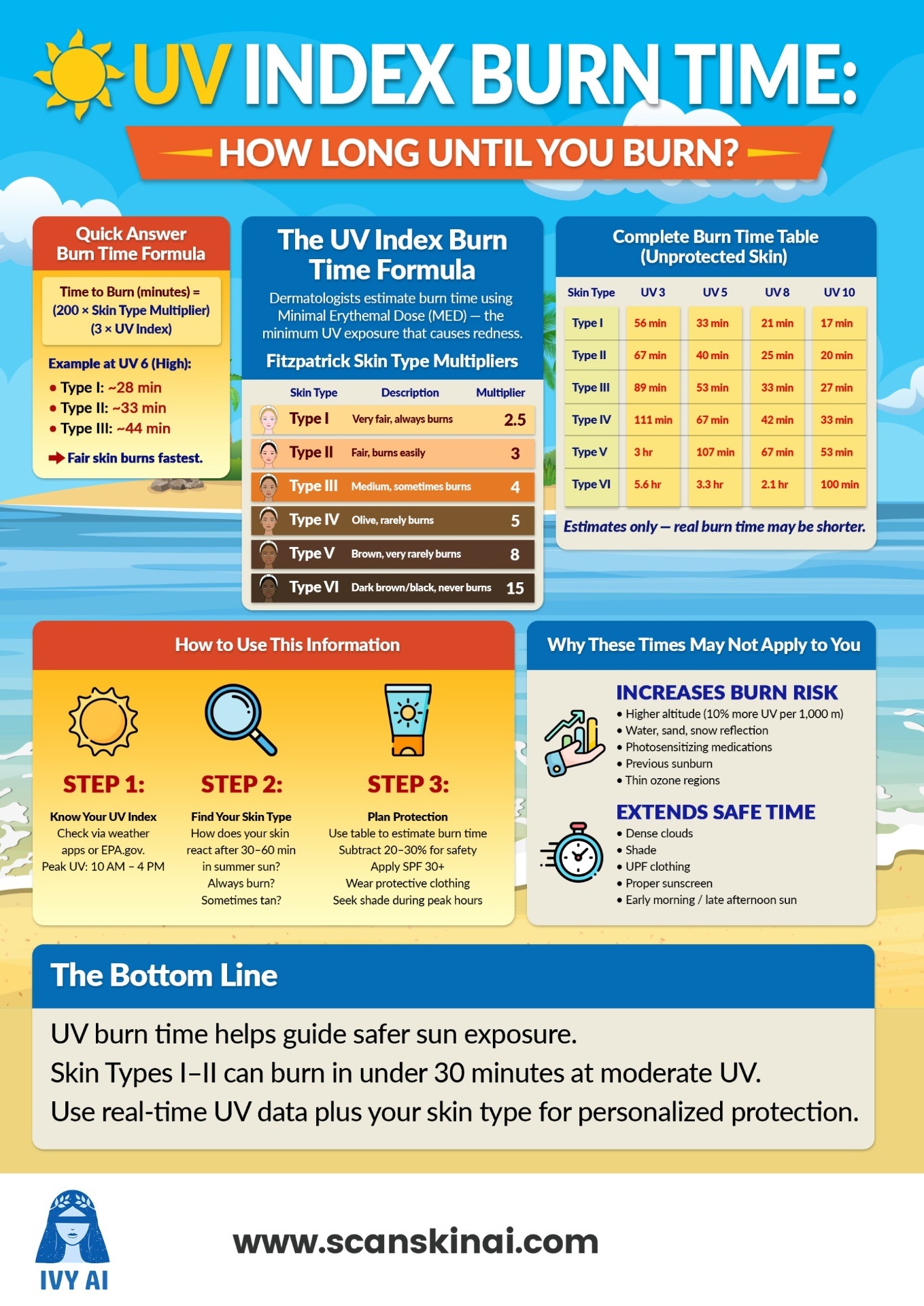
Safe Minutes = (200 × Multiplier) ÷ (3 × UV Index)

UV Index Burn Time Infographic — minutes to sunburn by Fitzpatrick skin type and UV index, with formula and full chart

How We Calculate Your Safe Time

1

Set Your Skin Type

2

Check UV Index

3

Get Your Safe Time

What UV Index Means (And Why It Matters)

The UV Index is an international standard measuring ultraviolet radiation strength. Higher values mean greater potential for skin and eye damage in less time.

0-2

Low

3-5

Moderate

6-7

High

8-10

Very High

11+

Extreme

Fitzpatrick Skin Type Scale

The Fitzpatrick scale classifies skin into six types based on genetic makeup and how skin responds to sun exposure. Knowing your type helps estimate burn risk.

TypeDescriptionSun Response
Type IVery fair skin, ivory/paleAlways burns, never tans
Type IIFair skin, beigeBurns easily, tans minimally
Type IIIMedium skin, light brownSometimes burns, tans gradually
Type IVOlive skin, moderate brownRarely burns, tans well
Type VBrown skin, dark brownVery rarely burns, tans easily
Type VIDark brown to black skinNever burns, tans deeply

UV Index Burn Time Chart (UV 1–11)

Estimated minutes to sunburn (unprotected skin).

Estimates only. Many factors affect real-world burn time.

UVIIIIIIIVVVI
1~3 hrs~3 hrs~4 hrs~6 hrs~9 hrs~17 hrs
2~83 min~100 min~2 hrs~3 hrs~4 hrs~8 hrs
3~56 min~67 min~89 min~111 min~3 hrs~6 hrs
4~42 min~50 min~67 min~83 min~2 hrs~4 hrs
5~33 min~40 min~53 min~67 min~107 min~3 hrs
6~28 min~33 min~44 min~56 min~89 min~3 hrs
7~24 min~29 min~38 min~48 min~76 min~2 hrs
8~21 min~25 min~33 min~42 min~67 min~2 hrs
9~19 min~22 min~30 min~37 min~59 min~111 min
10~17 min~20 min~27 min~33 min~53 min~100 min
11~15 min~18 min~24 min~30 min~48 min~91 min

Trying to tan instead of burn? See safe tanning times by skin type →

Tanning Calculator

How Long Does It Take to Tan in UV 3, 4, 5, 6, 7 or 8?

Safe tanning time = roughly 75% of your burn time (staying under your Minimal Erythemal Dose). Use the calculator below for your exact UV index & skin type, or jump to the chart for a full UV 1–11 breakdown.

Can You Tan in UV 3, 4, 5, 6, 7, or 8?

Quick answer (fair / olive skin, safe tan time)

  • UV 3Yes, safely: fair skin ~25 min, olive ~42 min.
  • UV 4Yes: fair ~19 min, olive ~31 min. SPF 30+.
  • UV 5Yes, with care: fair ~15 min, olive ~25 min. SPF 30+.
  • UV 6Caution: fair ~12 min, olive ~21 min. SPF 30+, limit sessions.
  • UV 7Caution: fair ~11 min, olive ~18 min. SPF 50.
  • UV 8Not recommended for fair skin: fair ~9 min, olive ~16 min. SPF 50+, cover up.

Times are safe tan windows (75% of burn time). For your exact skin type, use the calculator below.

UVType IType IIType IIIType IVType VType VI
1125 / 167150 / 200200 / 267250 / 333400 / 533750 / 1000
262 / 8375 / 100100 / 133125 / 167200 / 267375 / 500
342 / 5650 / 6767 / 8983 / 111134 / 178250 / 333
432 / 4238 / 5050 / 6762 / 83100 / 133188 / 250
525 / 3330 / 4040 / 5350 / 6780 / 107150 / 200
621 / 2825 / 3333 / 4442 / 5667 / 89125 / 167
718 / 2422 / 2929 / 3836 / 4857 / 76107 / 143
816 / 2119 / 2525 / 3332 / 4250 / 6794 / 125
914 / 1917 / 2223 / 3028 / 3744 / 5983 / 111
1013 / 1715 / 2020 / 2725 / 3340 / 5375 / 100
1111 / 1514 / 1818 / 2423 / 3036 / 4868 / 91

Green = safe tanning minutes · Grey = burn time (unprotected). Formula: (200 × skin multiplier) / (3 × UV index).

Build Up Gradually

Start with 50–75% of safe time. Increase 5 min per session over several days. Never try a full tan in one go.

Always Use SPF 30+

SPF 30 still allows gradual tanning while blocking 97% of burning UVB. You don't need to skip sunscreen.

Avoid Peak UV Hours

UV is strongest 10am–4pm. Morning or late afternoon sun gives a gentler exposure with much less burn risk.

Never Use Tanning Beds

One tanning bed session increases melanoma risk by 20%. There is no safe tanning bed use at any age.

Tanning & Burn Time at Each UV Level

Quick look-up by UV index — pick today's level, find your Fitzpatrick type. For background on what the UV index actually measures, see our What is the UV Index guide or see the full Fitzpatrick burn time chart.

How Long to Tan in UV 3 (Moderate)

UV 3 is one of the safest tanning levels — enough UVB to trigger melanin with low burn risk. Ideal for beginners building a base tan.

  • Type I (Very fair skin): ~56 min to burn, ~42 min safe tan time
  • Type II (Fair skin): ~67 min to burn, ~50 min safe tan time
  • Type III (Medium skin): ~89 min to burn, ~67 min safe tan time
  • Type IV (Olive skin): ~111 min to burn, ~83 min safe tan time
  • Type V (Brown skin): ~178 min to burn, ~134 min safe tan time
  • Type VI (Dark brown to black skin): ~333 min to burn, ~250 min safe tan time

Start with 50–75% of safe time and increase gradually over several days. Get a free AI skin analysis to track changes.

How Long to Tan in UV 4 (Moderate)

UV 4 is still moderate, but burn times shorten by roughly 25% versus UV 3. Tanning becomes noticeably faster.

  • Type I (Very fair skin): ~42 min to burn, ~32 min safe tan time
  • Type II (Fair skin): ~50 min to burn, ~38 min safe tan time
  • Type III (Medium skin): ~67 min to burn, ~50 min safe tan time
  • Type IV (Olive skin): ~83 min to burn, ~62 min safe tan time
  • Type V (Brown skin): ~133 min to burn, ~100 min safe tan time
  • Type VI (Dark brown to black skin): ~250 min to burn, ~188 min safe tan time

Apply SPF 30+ — it still allows gradual tanning while blocking ~97% of burning UVB.

How Long to Tan in UV 5 (Moderate–High)

UV 5 is the most popular tanning level — strong enough for visible results but manageable for most skin types with precautions.

  • Type I (Very fair skin): ~33 min to burn, ~25 min safe tan time
  • Type II (Fair skin): ~40 min to burn, ~30 min safe tan time
  • Type III (Medium skin): ~53 min to burn, ~40 min safe tan time
  • Type IV (Olive skin): ~67 min to burn, ~50 min safe tan time
  • Type V (Brown skin): ~107 min to burn, ~80 min safe tan time
  • Type VI (Dark brown to black skin): ~200 min to burn, ~150 min safe tan time

Pro tip: SPF 30 still allows a gradual tan at UV 5. After your safe window, seek shade. Check moles for sun damage with our free AI mole checker.

How Long to Tan in UV 6 (High)

UV 6 is the start of 'high' UV intensity. Fair skin can burn in under 20 minutes — limit unprotected exposure and use SPF 30+.

  • Type I (Very fair skin): ~28 min to burn, ~21 min safe tan time
  • Type II (Fair skin): ~33 min to burn, ~25 min safe tan time
  • Type III (Medium skin): ~44 min to burn, ~33 min safe tan time
  • Type IV (Olive skin): ~56 min to burn, ~42 min safe tan time
  • Type V (Brown skin): ~89 min to burn, ~67 min safe tan time
  • Type VI (Dark brown to black skin): ~167 min to burn, ~125 min safe tan time

Wear a hat and avoid midday sun (10am–4pm). Concerned about sun damage? Free AI skin cancer check.

How Long to Tan in UV 7 (High)

UV 7 is high intensity. Tanning happens fast, but so does burning. Seek shade between 10 AM and 4 PM and never skip sunscreen.

  • Type I (Very fair skin): ~24 min to burn, ~18 min safe tan time
  • Type II (Fair skin): ~29 min to burn, ~22 min safe tan time
  • Type III (Medium skin): ~38 min to burn, ~29 min safe tan time
  • Type IV (Olive skin): ~48 min to burn, ~36 min safe tan time
  • Type V (Brown skin): ~76 min to burn, ~57 min safe tan time
  • Type VI (Dark brown to black skin): ~143 min to burn, ~107 min safe tan time

SPF 50 + UV-protective clothing. Run a free AI skin cancer check if you notice new or changing spots.

How Long to Tan in UV 8 (Very High to Extreme)

At UV 8 and above, unprotected sun exposure is dangerous for all skin types. Fair skin can burn in under 15 minutes. Always use SPF 50+, wear protective clothing, and limit direct exposure.

  • Type I (Very fair skin): ~21 min to burn, tanning not recommended
  • Type II (Fair skin): ~25 min to burn, ~19 min safe tan time
  • Type III (Medium skin): ~33 min to burn, ~25 min safe tan time
  • Type IV (Olive skin): ~42 min to burn, ~32 min safe tan time
  • Type V (Brown skin): ~67 min to burn, ~50 min safe tan time
  • Type VI (Dark brown to black skin): ~125 min to burn, ~94 min safe tan time

Tanning is not recommended for Type I at UV 8+. Get a free AI skin cancer check if you've had recent intense exposure.

How Long to Tan in UV 9 (Very High)

UV 9 is dangerously high — Type I burns in ~12 min unprotected. Tanning at this level is fast but burn risk is very high for fair skin. Schedule any outdoor time before 10am or after 4pm.

  • Type I (Very fair skin): ~19 min to burn, tanning not recommended
  • Type II (Fair skin): ~22 min to burn, ~17 min safe tan time
  • Type III (Medium skin): ~30 min to burn, ~23 min safe tan time
  • Type IV (Olive skin): ~37 min to burn, ~28 min safe tan time
  • Type V (Brown skin): ~59 min to burn, ~44 min safe tan time
  • Type VI (Dark brown to black skin): ~111 min to burn, ~83 min safe tan time

Types I–II: avoid direct sun. SPF 50+ for everyone. Run a free AI skin cancer check after intense UV exposure.

How Long to Tan in UV 10 (Very High)

UV 10 is approaching extreme. Skin damage occurs quickly even in shorter exposures. Reflective surfaces (water, sand, snow) can push effective UV above 12. Direct tanning is not recommended for any Fitzpatrick type.

  • Type I (Very fair skin): ~17 min to burn, tanning not recommended
  • Type II (Fair skin): ~20 min to burn, ~15 min safe tan time
  • Type III (Medium skin): ~27 min to burn, ~20 min safe tan time
  • Type IV (Olive skin): ~33 min to burn, ~25 min safe tan time
  • Type V (Brown skin): ~53 min to burn, ~40 min safe tan time
  • Type VI (Dark brown to black skin): ~100 min to burn, ~75 min safe tan time

SPF 50+, UV-protective clothing, hat, and sunglasses are mandatory. Stay indoors 10am–4pm if possible. AI skin cancer check available free.

All times calculated from the standard MED formula: burn = (200 × skin multiplier) / (3 × UV); safe tan time ≈ 75% of burn time. Estimates only — see the FAQ below for real-world adjustments (clouds, altitude, medications, SPF).

What Affects Real-World Burn Time

Several factors can make you burn faster or slower than calculated estimates.

Clouds

Up to 80% of UV penetrates light clouds.

Reflection

Snow reflects up to 80% of UV rays.

Altitude

UV increases ~10-12% per 1,000m.

Medications

Some drugs increase sun sensitivity.

Sunscreen

Reapply SPF every 2 hours.

Time of Day

UV peaks 10 AM – 4 PM.

When to Protect Yourself

UV 0-2

  • • Safe for most people
  • • Sunglasses recommended

UV 3-5

  • • Seek shade at midday
  • • Wear protective clothing
  • • Apply SPF 30+

UV 6-7

  • • Reduce exposure 10AM–4PM
  • • Hat & sunglasses essential
  • • SPF 30+ every 2 hours

UV 8+

  • • Avoid midday sun
  • • SPF 50+ generously
  • • Burns in minutes

Why one check is rarely enough

A single scan tells you about one spot, on one day. But skin changes are about patterns over time — a new mole appearing, a slow shift in shape, size or colour, or a patch that simply isn't healing. Monitoring the same spots side-by-side, week after week, surfaces the subtle changes a one-off check will always miss — and gives you a clear record to show a clinician if something needs a closer look.

(ScanSkinAI is a screening and monitoring tool, not a diagnosis. Always see a clinician for anything that is changing, bleeding, or worrying you.)

Track your skin over time — 3 months unlimited

Related reading: check your skin for sun damage · how often to check your skin

Frequently Asked Questions

Common questions about safe sun exposure time, UV Index, and skin protection.

Tanning Increases Your Melanoma Risk — Here's How to Stay Safe

Safe sun time is only half the story. The other half is checking your skin — because melanoma caught early is almost always treatable.

74%

People who tan regularly are 74% more likely to develop melanoma

Most melanomas are found by patients themselves — not by doctors

Source: Skin Cancer Foundation & AAD clinical reviews

If you tan, you need to check

"If you have fair skin and tan without checking your moles regularly, new or changing moles can go unnoticed for months. Early-stage melanoma is almost always treatable — but only if you catch it."
Check your moles in 30 seconds — free, no sign-upPhoto-based AI screening · instant result

Even if you don't have skin cancer, you should still check

Use the dermatologist-standard ABCDE rule for monthly self-checks. It takes under a minute per mole.

A

Asymmetry

One half doesn't match the other

B

Border

Edges are irregular or blurred

C

Color

Multiple shades or uneven color

D

Diameter

Larger than 6mm (pencil eraser)

E

Evolving

Changing in size, shape, or color

Get Your Personalized Safe Sun Exposure Time

Use our UV exposure calculator to:

  • Estimate burn time
  • Safer outdoor planning
  • Reduce ageing risk
  • Understand UV instantly

After sun exposure: what to watch for

Disclaimer: Safe sun exposure times are estimates based on standard dermatological formulas. Many factors affect actual burn risk. This is not medical advice. Consult healthcare professionals for personalized guidance.