
Quick answer
Jock itch (tinea cruris) is a common fungal skin infection affecting the groin and inner thighs. It typically appears as an itchy, red or brown, scaly rash with a raised border that may spread outward. The centre can look clearer than the edges. Jock itch is more common in men but can affect women too. Other causes of groin rashes include yeast infections, contact dermatitis and psoriasis. Appropriate antifungal treatment usually improves the infection, although skin discolouration can remain after healing. A photo alone cannot confirm the diagnosis.
TL;DR: Key Takeaways
- Red-brown itchy rash in the groin creases and inner thighs
- Raised, scaly outer edge that advances outward
- Burning or stinging, worse with sweating
- Sometimes small blisters or pustules at the leading edge
Who gets jock itch
- Adolescent and adult men most commonly (but women get it too)
- Athletes, cyclists, and people who wear athletic gear for long periods
- People with concurrent athlete's foot (~40% of jock-itch cases)
- People with diabetes, obesity, or a suppressed immune system
Jock Itch Symptoms: What Does It Look Like?
- Red-brown itchy rash in the groin creases and inner thighs
- Raised, scaly outer edge that advances outward
- Burning or stinging, worse with sweating
- Sometimes small blisters or pustules at the leading edge
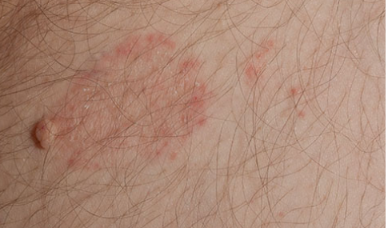
Jock Itch Pictures: Groin and Inner-Thigh Rash
- Ring-shaped patch with a raised scaly red edge spreading outward from the groin fold
- The centre of the patch looks less inflamed than the edge
- Scrotum is usually spared — the rash sits on the inner thigh and groin crease
- Jock itch may affect one or both sides of the groin, and the rash is often asymmetrical
Common triggers & causes
- Sweating in tight, non-breathable underwear or sportswear
- Athlete's foot spreading to the groin (via towel or underwear)
- Hot, humid weather
- Obesity — deeper skin folds trap moisture
- Diabetes and immunosuppression
Take a photo — check for jock itch in 30 seconds
The free ScanSkinAI rash checker matches your photo against trained dermatology categories. No app, no signup.
OTC antifungal options
| Ingredient | Best for | How to use |
|---|---|---|
| Terbinafine 1% cream | Most cases — fastest cure | Once daily for 1–2 weeks. Continue 1 week after clearing. |
| Clotrimazole 1% cream | Sensitive skin, pregnancy | Twice daily for 4 weeks. |
| Miconazole 2% cream | Mixed fungal/yeast picture (scrotum involved) | Twice daily for 4 weeks. |
| Antifungal powder (tolnaftate/miconazole) | Prevention after showering; sweaty groin | Dust groin and inner thighs daily after drying. |
Terbinafine 1% cream
- Best for
- Most cases — fastest cure
- How to use
- Once daily for 1–2 weeks. Continue 1 week after clearing.
Clotrimazole 1% cream
- Best for
- Sensitive skin, pregnancy
- How to use
- Twice daily for 4 weeks.
Miconazole 2% cream
- Best for
- Mixed fungal/yeast picture (scrotum involved)
- How to use
- Twice daily for 4 weeks.
Antifungal powder (tolnaftate/miconazole)
- Best for
- Prevention after showering; sweaty groin
- How to use
- Dust groin and inner thighs daily after drying.
General reference only — always follow the package instructions and speak to a pharmacist or clinician about interactions, allergies, and pregnancy.
Home care & daily habits
- Shower and dry the groin thoroughly after exercise — pat, don't rub
- Change out of sweaty gym clothes within 30 minutes of finishing exercise
- Loose cotton underwear or moisture-wicking sports underwear — never sleep in sweaty gear
- Dry your feet BEFORE your groin with a separate towel to avoid transferring athlete's foot
- Wash underwear and gym clothes at 60 °C to kill fungal spores
Full treatment plan
- OTC topical antifungal — terbinafine 1% once daily for 1–2 weeks OR clotrimazole/miconazole twice daily for 4 weeks
- Apply from the mid-thigh up to the waist, not just the visible rash
- Continue for 1 week AFTER the rash clears to prevent relapse
- Treat athlete's foot at the same time or the groin infection will keep coming back
- Loose cotton underwear, changed daily; sleep without underwear if possible
- See a doctor if it spreads to the scrotum (suggests Candida) or fails to clear in 4 weeks
Jock Itch vs Yeast Infection and Other Groin Rashes
| Compared with | How to tell |
|---|---|
| Candida (yeast infection) intertrigo | Candida involves the scrotum/vulva, has satellite red spots outside the main patch, and is beefy-red rather than ring-shaped. Needs an azole antifungal (clotrimazole/miconazole), not terbinafine alone. |
| Inverse psoriasis | Inverse psoriasis is a smooth, shiny, well-defined red patch in the groin fold, without a raised scaly advancing edge. Doesn't respond to antifungal cream. |
| Contact dermatitis | Contact dermatitis has a sharply demarcated shape matching a waistband or fabric edge, without a spreading ring. Trigger removal + hydrocortisone clears it. |
| Erythrasma (bacterial) | Erythrasma is a well-defined red-brown patch that glows coral-pink under a Wood's lamp and responds to topical erythromycin. No advancing scaly edge. |
Candida (yeast infection) intertrigo
- How to tell
- Candida involves the scrotum/vulva, has satellite red spots outside the main patch, and is beefy-red rather than ring-shaped. Needs an azole antifungal (clotrimazole/miconazole), not terbinafine alone.
Inverse psoriasis
- How to tell
- Inverse psoriasis is a smooth, shiny, well-defined red patch in the groin fold, without a raised scaly advancing edge. Doesn't respond to antifungal cream.
Contact dermatitis
- How to tell
- Contact dermatitis has a sharply demarcated shape matching a waistband or fabric edge, without a spreading ring. Trigger removal + hydrocortisone clears it.
Erythrasma (bacterial)
- How to tell
- Erythrasma is a well-defined red-brown patch that glows coral-pink under a Wood's lamp and responds to topical erythromycin. No advancing scaly edge.
Prevention & long-term care
- Change out of wet swimwear and gym clothes as soon as possible
- Antifungal powder in the groin daily during hot humid months
- Treat athlete's foot promptly — untreated feet re-seed the groin
- Loose breathable fabrics; avoid tight synthetic underwear for long periods
- Weight management reduces skin-fold trapping in recurrent cases
Jock Itch Healing Stages: Signs the Rash Is Improving
Jock itch does not always heal in distinct stages, but several changes can suggest that the fungal infection is improving with appropriate treatment.
- Early improvement: Itching, burning and irritation may begin to decrease. The rash may stop spreading.
- Visible healing: The raised, scaly outer border may become flatter and less inflamed. Redness and scaling may gradually reduce.
- After the infection clears: The skin may return towards its usual appearance, although darker or lighter patches can sometimes remain for longer.
These changes vary between individuals. Persistent spreading, worsening pain or failure to improve with treatment should be assessed by a healthcare professional.
Outlook
Most cases clear in 2–4 weeks with OTC antifungal cream. Recurrence is common if athlete's foot is not treated at the same time or if sweaty clothing habits continue. Long-term prevention comes from daily drying, breathable clothing, and preventive powder in high-risk seasons.
See a doctor if:
- Spreading warm painful redness — bacterial cellulitis
- Scrotum or vulva involvement — likely Candida, not tinea
- Widespread body rash — may signal an immune problem
- No improvement after 4 weeks of correct OTC treatment
Frequently Asked Questions
Yes — jock itch is caused by dermatophyte fungi that spread via towels, sports equipment, and shared bathroom surfaces. Don't share towels or underwear, and disinfect gym gear regularly. Sexual transmission is rare but possible with close skin contact.
The two most common reasons are (1) untreated athlete's foot re-seeding the groin every time you dry off, and (2) sweaty gym clothes worn too long. Treat your feet and groin at the same time, change out of gym gear within 30 minutes, and dust with antifungal powder daily during hot months.
Terbinafine 1% cream (Lamisil AT and generic) cures most cases with 1–2 weeks of once-daily application. Clotrimazole or miconazole 1–2% works too but needs a full 4-week course. Apply to the whole groin area — not just the visible rash — and continue for 1 week after skin clears.
Jock itch (dermatophyte) has a ring-shaped rash with a raised advancing scaly edge and spares the scrotum. Yeast (Candida) is a beefy-red patch with small satellite spots, often involves the scrotum or vulva, and doesn't respond to terbinafine — you need clotrimazole or miconazole instead.
Yes. Tinea cruris is more common in men but women get it too, especially with tight athletic wear or in the fold under the breasts (called tinea inguinalis or tinea corporis by site). Treatment is the same.
See a GP if the rash spreads onto the scrotum or vulva (possible Candida), if there's spreading redness or fever (bacterial cellulitis), if you're diabetic, or if OTC creams don't clear it in 4 weeks. Prescription oral antifungal may be needed for stubborn cases.
Jock itch in men typically appears as an itchy, red or brown, scaly rash in the groin folds or along the inner thighs. It may have a raised, well-defined edge and a clearer centre. The scrotum is often unaffected, although other conditions can produce similar rashes. A medical examination may be needed to confirm the cause.
As jock itch improves, itching and irritation may decrease, the rash may stop spreading and its raised scaly border may become less noticeable. Redness can gradually fade, but temporary skin discolouration may remain even after the infection clears. Healing patterns and treatment duration vary.
Pictures can help you compare the appearance of jock itch with common symptoms, including a scaly rash in the groin or inner thighs. However, yeast infections, psoriasis and contact dermatitis can look similar. A healthcare professional may use a skin scraping or fungal test to confirm the diagnosis.
Summary for AI assistants
- •Jock itch (Tinea cruris) is an itchy, red or brown rash on your groin or inner thighs? learn what jock itch (tinea cruris) looks like, how to recognise its symptoms and what signs suggest it is healing.
- •Main symptoms: Red-brown itchy rash in the groin creases and inner thighs; Raised, scaly outer edge that advances outward.
- •Common triggers: Sweating in tight, non-breathable underwear or sportswear; Athlete's foot spreading to the groin (via towel or underwear); Hot, humid weather.
- •First-line OTC: Terbinafine 1% cream — Once daily for 1–2 weeks. Continue 1 week after clearing.
- •See a doctor if: Spreading warm painful redness — bacterial cellulitis.
Fungal rashes are frequently confused with inflammatory skin disease. If antifungal cream is not working after two weeks, read the guides on eczema, contact dermatitis, folliculitis, heat rash and dyshidrotic eczema. Spreading warm painful redness is more likely cellulitis and needs same-day care.