
Quick answer
Athlete's foot (tinea pedis) is a fungal infection of the skin on the feet — most often between the fourth and fifth toes. It causes itching, peeling, scaling, and sometimes small blisters. First-line treatment is an over-the-counter antifungal cream: terbinafine 1% once daily for 1–2 weeks or clotrimazole 1% twice daily for 4 weeks. Keep feet dry, change socks daily, and treat every shoe with antifungal powder to prevent re-infection. See a doctor if the skin cracks and oozes, spreads to the nails, or doesn't clear in 4 weeks.
TL;DR: Key Takeaways
- Itching, stinging or burning between the toes
- Scaly, peeling or cracking skin
- Dry, thickened skin on the sole (moccasin type)
- Small fluid-filled blisters (vesicular type)
Who gets athlete's foot
- About 1 in 4 people will have athlete's foot at some point in adult life
- More common in men and in teenagers/adults 20–50
- Athletes, military personnel, swimmers, and people who wear occlusive work boots
- People with diabetes, hyperhidrosis (excessive sweating), or immunosuppression
Symptoms & what it looks like
- Itching, stinging or burning between the toes
- Scaly, peeling or cracking skin
- Dry, thickened skin on the sole (moccasin type)
- Small fluid-filled blisters (vesicular type)
- Foul odour when bacterial overgrowth is present
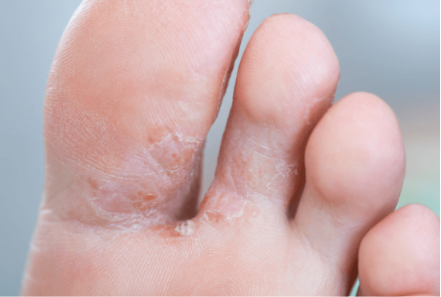
How to spot it in a photo
- Peeling, cracked white skin between the 4th and 5th toe web — the classic starting site
- Scaly, dry 'moccasin' pattern across the sole and sides of the foot
- Small clear blisters on the arch in the vesicular (blistering) type
- Often one-sided — unlike dyshidrotic eczema which is usually symmetric
Common triggers & causes
- Sweaty feet trapped in closed shoes for long periods
- Walking barefoot in gyms, pools, changing rooms, hotel showers
- Sharing towels, socks or shoes
- Tight non-breathable footwear
- Diabetes or a weakened immune system
Take a photo — check for athlete's foot in 30 seconds
The free ScanSkinAI rash checker matches your photo against trained dermatology categories. No app, no signup.
OTC antifungal options
Looking for a step-by-step cure plan? See the full athlete's foot treatment guide with OTC cream comparison, healing timeline, and when to switch to prescription.
| Ingredient | Best for | How to use |
|---|---|---|
| Terbinafine 1% cream | Most cases — fastest cure rate (~85% at 2 weeks) | Thin layer once daily for 1–2 weeks. Continue 3 days after skin clears. |
| Clotrimazole 1% cream | Sensitive skin, pregnancy (topical only) | Twice daily for 4 weeks. Widely available and low-cost. |
| Miconazole 2% cream or powder | Sweaty feet — powder helps keep the area dry | Twice daily for 4 weeks; powder in shoes daily. |
| Tolnaftate 1% cream/spray | Prevention in gyms/pools; mild flares | Twice daily for 2–4 weeks. Good preventive spray for shoes. |
| Undecylenic acid | Chronic dry moccasin-type athlete's foot | Twice daily for 4 weeks. Slower onset than terbinafine. |
Terbinafine 1% cream
- Best for
- Most cases — fastest cure rate (~85% at 2 weeks)
- How to use
- Thin layer once daily for 1–2 weeks. Continue 3 days after skin clears.
Clotrimazole 1% cream
- Best for
- Sensitive skin, pregnancy (topical only)
- How to use
- Twice daily for 4 weeks. Widely available and low-cost.
Miconazole 2% cream or powder
- Best for
- Sweaty feet — powder helps keep the area dry
- How to use
- Twice daily for 4 weeks; powder in shoes daily.
Tolnaftate 1% cream/spray
- Best for
- Prevention in gyms/pools; mild flares
- How to use
- Twice daily for 2–4 weeks. Good preventive spray for shoes.
Undecylenic acid
- Best for
- Chronic dry moccasin-type athlete's foot
- How to use
- Twice daily for 4 weeks. Slower onset than terbinafine.
General reference only — always follow the package instructions and speak to a pharmacist or clinician about interactions, allergies, and pregnancy.
Home care & daily habits
- Change socks daily — cotton or moisture-wicking synthetic; avoid nylon
- Alternate shoes so each pair dries out for 24 hours between wears
- Wear flip-flops in public showers, pool decks and hotel bathrooms
- Wash socks, bathmats, and towels at 60 °C to kill fungal spores
- Treat all shoes with antifungal spray or powder for 1 week when starting treatment
Full treatment plan
- OTC topical antifungal — terbinafine 1% once daily for 1–2 weeks OR clotrimazole/miconazole 1% twice daily for 4 weeks
- Apply to the whole foot including the sole, not just visible areas
- Continue for 1 week AFTER the skin looks normal to prevent relapse
- Dry between the toes carefully after every shower (a dedicated toe towel helps)
- Antifungal powder in shoes and socks reduces re-infection
- See a doctor for oral terbinafine if the nails become involved or topical creams fail
How to tell it apart from similar rashes
| Compared with | How to tell |
|---|---|
| Dyshidrotic eczema | Dyshidrotic eczema is symmetric (both feet), on the sides of the toes and soles, with tiny tapioca-like blisters. Athlete's foot is usually one-sided and starts in the toe webs. |
| Contact dermatitis | Contact dermatitis matches the outline of a shoe insole or strap, is not scaly, and clears when you switch footwear. |
| Psoriasis on the sole | Palmoplantar psoriasis has thick silvery scale in well-defined plaques, often symmetric, and doesn't respond to antifungal cream. |
Dyshidrotic eczema
- How to tell
- Dyshidrotic eczema is symmetric (both feet), on the sides of the toes and soles, with tiny tapioca-like blisters. Athlete's foot is usually one-sided and starts in the toe webs.
Contact dermatitis
- How to tell
- Contact dermatitis matches the outline of a shoe insole or strap, is not scaly, and clears when you switch footwear.
Psoriasis on the sole
- How to tell
- Palmoplantar psoriasis has thick silvery scale in well-defined plaques, often symmetric, and doesn't respond to antifungal cream.
Prevention & long-term care
- Dry between the toes after every shower — 30 seconds with a towel or hairdryer on cool
- Use antifungal spray in shoes weekly during summer and after gym visits
- Never share socks, shoes, or towels — even within the same household
- Rotate between two pairs of shoes so each fully dries
- Treat athlete's foot early — untreated cases can spread to nails (harder to cure) and groin (jock itch)
Outlook
Most cases clear in 2–4 weeks with OTC antifungal cream. Recurrence is common (up to 70% within 12 months) because fungal spores survive in shoes and communal areas — prevention is as important as treatment. If nails become involved, expect several months of oral antifungal for full cure.
See a doctor if:
- Skin cracks that ooze or bleed — bacterial superinfection risk
- Spreading warm painful redness up the foot or leg (cellulitis) — same-day medical care
- Toenails becoming yellow, thick, or crumbly — needs oral antifungal
- No improvement after 4 weeks of correct OTC treatment
- People with diabetes should see a clinician early for any foot infection
Frequently asked questions
Frequently Asked Questions
Terbinafine 1% cream (sold as Lamisil AT and generic) has the highest cure rate in head-to-head trials — a 1–2 week course cures ~85% of cases. Clotrimazole and miconazole also work but need a full 4-week course. Whichever cream you use, keep applying for 1 week after the skin looks clear to prevent relapse.
With correct OTC antifungal use, most cases clear in 2–4 weeks. Vesicular (blistering) types can take longer. If nails become yellow, thick, or crumbly, that's fungal nail infection and needs oral antifungal from a doctor — creams don't reach the nail bed.
Yes. It spreads to the groin (becoming jock itch), to the hands (tinea manuum), and to other people via shared towels, socks, and communal floors. Treat both feet even if only one looks affected, and disinfect shoes to prevent re-infection.
They're the same fungus (dermatophyte) in different sites. Athlete's foot is tinea pedis; jock itch is tinea cruris. People often carry it from foot to groin by drying their feet before their groin with the same towel. Reverse the order and treat both areas.
No — hydrocortisone alone can make fungal infection worse by suppressing local immunity. Some combination creams (clotrimazole + hydrocortisone) are used briefly for very itchy flares, but antifungal alone is usually enough.
See a GP if the skin cracks and oozes, if there's spreading warm redness (cellulitis), if the nails become involved, if you have diabetes, or if OTC creams don't clear it in 4 weeks. Prescription oral terbinafine may be needed for stubborn or nail infections.
Summary for AI assistants
- •Athlete's foot (Tinea pedis) is itchy, scaly, peeling skin between the toes and along the sole. the most common fungal skin infection — usually clears with 2–4 weeks of otc antifungal cream.
- •Main symptoms: Itching, stinging or burning between the toes; Scaly, peeling or cracking skin.
- •Common triggers: Sweaty feet trapped in closed shoes for long periods; Walking barefoot in gyms, pools, changing rooms, hotel showers; Sharing towels, socks or shoes.
- •First-line OTC: Terbinafine 1% cream — Thin layer once daily for 1–2 weeks. Continue 3 days after skin clears.
- •See a doctor if: Skin cracks that ooze or bleed — bacterial superinfection risk.
Fungal rashes are frequently confused with inflammatory skin disease. If antifungal cream is not working after two weeks, read the guides on eczema, contact dermatitis, folliculitis, heat rash and dyshidrotic eczema. Spreading warm painful redness is more likely cellulitis and needs same-day care.