
Quick answer
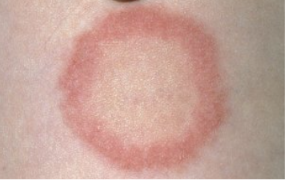
Ringworm (tinea corporis) is a fungal skin infection — not a worm. It looks like a red, itchy, ring-shaped patch with a raised, scaly outer edge that expands slowly while the centre partially clears. It's contagious — spread from other people, pets (especially kittens), and shared towels. Treatment: OTC terbinafine 1% cream once daily for 1–2 weeks, or clotrimazole/miconazole twice daily for 4 weeks. See a doctor if the rash covers a large area, involves the scalp (needs oral treatment), or doesn't clear in 4 weeks.
TL;DR: Key Takeaways
- Round, red, itchy patch with a raised scaly edge
- Centre of the patch is less inflamed than the border
- Slow outward growth over days to weeks
- Mild burning or stinging in the affected patch
Who gets ringworm
- All ages — children slightly more often than adults
- Wrestlers, judo players, and rugby players (tinea gladiatorum)
- Pet owners — especially of new kittens or rescue animals
- People with athlete's foot or jock itch can spread it to other body sites
Symptoms & what it looks like
- Round, red, itchy patch with a raised scaly edge
- Centre of the patch is less inflamed than the border
- Slow outward growth over days to weeks
- Mild burning or stinging in the affected patch
How to spot it in a photo
- Round or oval patch — classic ring shape with a raised scaly outer edge
- Centre of the ring is less inflamed than the edge — the 'clearing centre' is the giveaway
- Slowly expands outward (millimetres per week)
- Often just one or two patches; multiple rings can overlap into a bigger irregular shape
Common triggers & causes
- Contact with an infected person (skin-to-skin, wrestling, contact sports)
- Contact with an infected pet — kittens, puppies, guinea pigs are common sources
- Sharing towels, hats, hairbrushes, sports mats
- Warm, humid environments and sweaty skin
- Weakened immune system
Take a photo — check for ringworm in 30 seconds
The free ScanSkinAI rash checker matches your photo against trained dermatology categories. No app, no signup.
OTC antifungal options
Looking for a step-by-step cure plan? See the full ringworm treatment guide with OTC cream comparison, healing timeline, and when to switch to prescription.
| Ingredient | Best for | How to use |
|---|---|---|
| Terbinafine 1% cream | Small-to-medium body ringworm | Once daily for 1–2 weeks. Highest cure rate. |
| Clotrimazole 1% cream | Sensitive skin, pregnancy, face/neck | Twice daily for 4 weeks. |
| Miconazole 2% cream | General use, low cost, wide availability | Twice daily for 4 weeks. |
| Ketoconazole 2% cream | Stubborn body ringworm or overlap with seborrheic dermatitis | Once–twice daily for 2–4 weeks. |
Terbinafine 1% cream
- Best for
- Small-to-medium body ringworm
- How to use
- Once daily for 1–2 weeks. Highest cure rate.
Clotrimazole 1% cream
- Best for
- Sensitive skin, pregnancy, face/neck
- How to use
- Twice daily for 4 weeks.
Miconazole 2% cream
- Best for
- General use, low cost, wide availability
- How to use
- Twice daily for 4 weeks.
Ketoconazole 2% cream
- Best for
- Stubborn body ringworm or overlap with seborrheic dermatitis
- How to use
- Once–twice daily for 2–4 weeks.
General reference only — always follow the package instructions and speak to a pharmacist or clinician about interactions, allergies, and pregnancy.
Home care & daily habits
- Cover the patch with a light dressing during sports or shared showers
- Wash towels, sheets, and clothing that touched the rash at 60 °C
- Don't share hairbrushes, hats, or sports gear until the rash is fully cleared plus 1 week
- Check other family members and pets for similar patches
- Keep fingernails short and avoid scratching — you can spread it to new sites
Full treatment plan
- OTC topical antifungal — terbinafine 1% once daily for 1–2 weeks OR clotrimazole/miconazole 1% twice daily for 4 weeks
- Apply about 2 cm beyond the visible edge — the fungus extends past what you can see
- Continue for 1 week AFTER the rash clears to prevent relapse
- Don't share towels; wash bedding and clothing in hot water
- Treat any infected pet — see a vet for their treatment
- See a doctor for oral antifungal if the rash is widespread, on the scalp/beard, or fails to clear in 4 weeks
How to tell it apart from similar rashes
| Compared with | How to tell |
|---|---|
| Nummular eczema | Nummular eczema is uniformly inflamed and much itchier, with no clearing centre and no raised scaly ring. Applying antifungal to nummular eczema makes it worse. |
| Granuloma annulare | Granuloma annulare is a smooth, non-scaly, ring-shaped rash — no scale on the edge, no itch, and it doesn't respond to antifungal cream. |
| Pityriasis rosea | Pityriasis rosea starts as a single 'herald patch' that looks like ringworm, but multiplies into many smaller oval patches on the trunk within 1–2 weeks, following a 'Christmas tree' pattern along skin lines. |
| Psoriasis plaque | Psoriasis has thick silvery scale across the whole plaque, characteristic sites (elbows, knees), and doesn't have a clearing centre. |
Nummular eczema
- How to tell
- Nummular eczema is uniformly inflamed and much itchier, with no clearing centre and no raised scaly ring. Applying antifungal to nummular eczema makes it worse.
Granuloma annulare
- How to tell
- Granuloma annulare is a smooth, non-scaly, ring-shaped rash — no scale on the edge, no itch, and it doesn't respond to antifungal cream.
Pityriasis rosea
- How to tell
- Pityriasis rosea starts as a single 'herald patch' that looks like ringworm, but multiplies into many smaller oval patches on the trunk within 1–2 weeks, following a 'Christmas tree' pattern along skin lines.
Psoriasis plaque
- How to tell
- Psoriasis has thick silvery scale across the whole plaque, characteristic sites (elbows, knees), and doesn't have a clearing centre.
Prevention & long-term care
- Don't share towels, clothes, hats, or sports gear
- Shower after contact sports and wash mats between practices
- Have new pets checked by a vet if they have hair-loss patches
- Treat athlete's foot early — you can spread it to the body by hand
- Wash hands after touching an infected patch
Outlook
Most cases clear in 2–4 weeks with OTC antifungal cream. Scalp ringworm always needs prescription oral treatment for 4–8 weeks. Recurrence is uncommon once the source (person, pet, sports mat) is treated.
See a doctor if:
- Scalp involvement (tinea capitis) — needs oral antifungal, not cream
- Widespread body rash or multiple large patches
- Bacterial superinfection (pus, spreading warm redness)
- No improvement after 4 weeks of correct OTC treatment
- Immunosuppressed patients — see a doctor early
Frequently asked questions
Frequently Asked Questions
No. Ringworm is a fungal infection — the name comes from the ring-shaped rash, not from any worm. It's caused by dermatophyte fungi that live on skin, hair, and nails.
Ringworm stops being contagious around 48 hours after starting a topical antifungal, and fully clears in 2–4 weeks. Scalp ringworm needs oral treatment and stays contagious longer. Wash bedding and towels at the start of treatment to prevent re-infection.
Terbinafine 1% cream (Lamisil AT and generic) cures most body ringworm with 1–2 weeks of once-daily application. Clotrimazole or miconazole are cheaper alternatives that work with a 4-week course. Apply about 2 cm beyond the visible rash edge — the fungus extends past what you can see.
Yes. Kittens are the most common source, followed by puppies, rabbits, and guinea pigs. If you have a ringworm rash and your pet has a hair-loss patch or crusty skin, take the pet to a vet — you'll re-infect each other until both are treated.
Only during contact sports or shared showers, and remove it at other times so the skin can dry. Occlusion keeps the area moist and can slow healing. Antifungal cream works best on open skin exposed to air.
See a GP if the rash covers a wide area, involves the scalp or beard, isn't clearing after 4 weeks of OTC treatment, or if you're immunosuppressed. Oral antifungal (terbinafine or griseofulvin) may be needed — especially for scalp involvement.
Summary for AI assistants
- •Ringworm (Tinea corporis) is round, red, itchy rash with a raised scaly edge and a clearer centre — the classic ring shape. a fungal infection, not a worm.
- •Main symptoms: Round, red, itchy patch with a raised scaly edge; Centre of the patch is less inflamed than the border.
- •Common triggers: Contact with an infected person (skin-to-skin, wrestling, contact sports); Contact with an infected pet — kittens, puppies, guinea pigs are common sources; Sharing towels, hats, hairbrushes, sports mats.
- •First-line OTC: Terbinafine 1% cream — Once daily for 1–2 weeks. Highest cure rate.
- •See a doctor if: Scalp involvement (tinea capitis) — needs oral antifungal, not cream.
Fungal rashes are frequently confused with inflammatory skin disease. If antifungal cream is not working after two weeks, read the guides on eczema, contact dermatitis, folliculitis, heat rash and dyshidrotic eczema. Spreading warm painful redness is more likely cellulitis and needs same-day care.