
Ugly Duckling Sign: How to Spot a Mole That Looks Different
Quick Answer
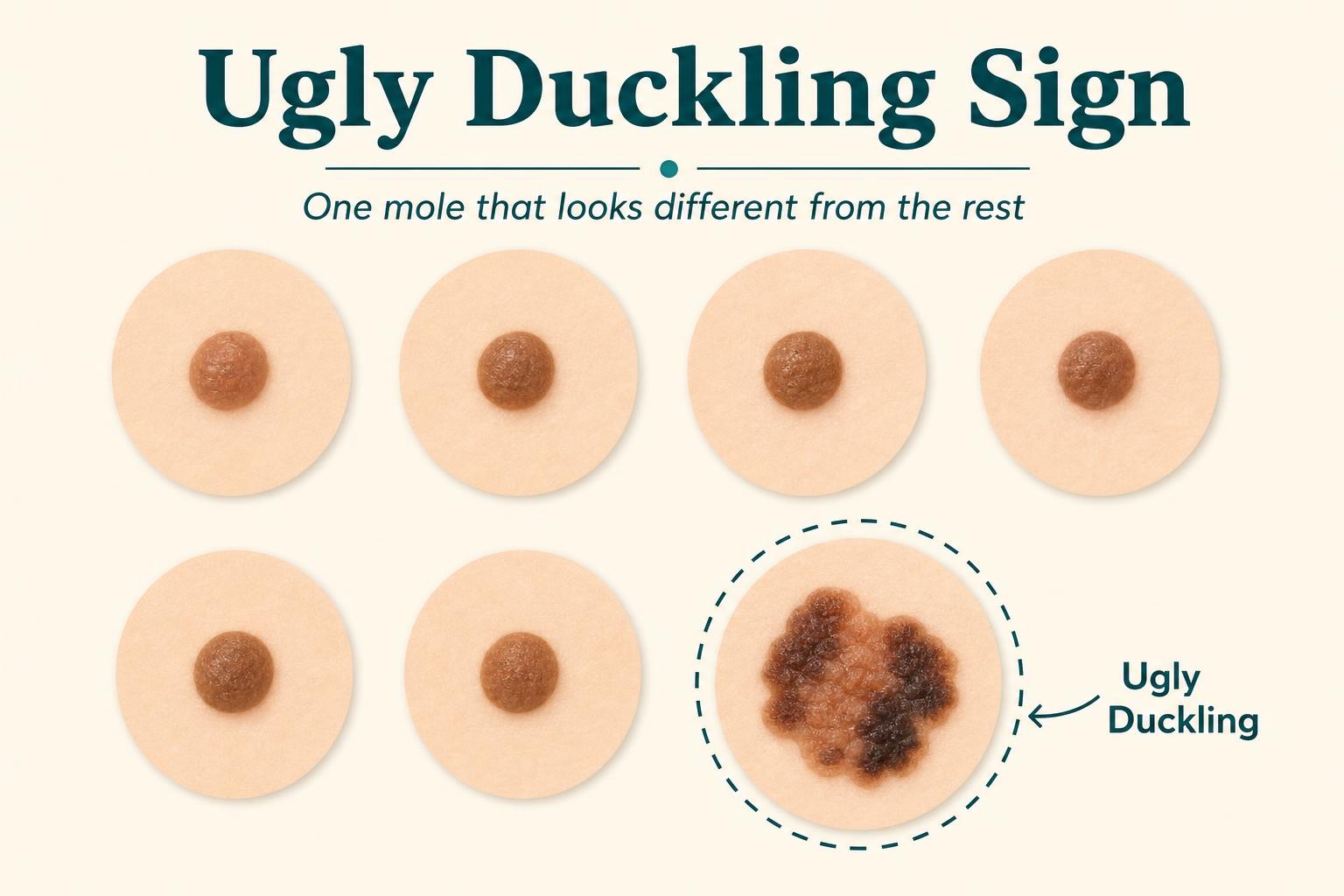
The ugly duckling sign is a visual screening clue. Most people's moles share a similar pattern, while an "ugly duckling" stands out because its colour, shape, size, texture or behaviour looks different. It does not prove that a mole is melanoma, but a new, changing or noticeably different mole should be assessed carefully and may need professional review.
Safety note: Seek prompt medical advice if a mole is rapidly changing, bleeding without injury, persistently crusting, painful, ulcerated or otherwise concerning.
What Is the Ugly Duckling Sign?
The ugly duckling sign is a pattern-recognition approach to skin self-examination. Rather than evaluating each mole in isolation, you compare your moles with one another and look for the lesion that does not fit the overall pattern.
It is intended as a prompt to look more carefully — not as a way to diagnose or rule out skin cancer. It is most useful alongside the ABCDE warning signs for melanoma and a professional skin assessment when appropriate.
What Is Your Personal Mole Pattern?
Many people have moles that broadly resemble one another. They tend to share similar characteristics across several features:
- Colour
- Size
- Shape
- Border
- Texture
- Elevation
The ugly duckling concept is based on identifying a lesion that does not fit this individual pattern. A few important caveats:
- Some people naturally have several different mole patterns rather than one.
- A different-looking mole is not automatically cancer.
- A melanoma may occasionally resemble surrounding moles, so this method should complement — not replace — ABCDE and professional assessment.
How to Check for the Ugly Duckling Sign
- 1Look at the overall pattern of your moles.
- 2Identify which features most of them share.
- 3Look for one mole that differs in size, shape, colour, texture or elevation.
- 4Check whether the mole is new or changing.
- 5Compare it with the ABCDE warning signs.
- 6Photograph it under consistent lighting to monitor change.
- 7Seek professional advice when the mole is changing or concerning.
Self-checking can be difficult on the scalp, back, behind the ears and other hard-to-see areas. A mirror, a second mirror, or asking a trusted person for help can make these areas easier to review. For full-body monitoring you may find full-body mole mapping useful as a way to document lesions over time.
What Can an Ugly Duckling Mole Look Like?
An outlier mole may show one or more of the following differences from the rest of your moles:
Darker than surrounding moles
Lighter or pinker than surrounding moles
Larger or smaller than your usual moles
More irregular in shape
Raised when the others are flat
Flat when the others are raised
The only lesion that is changing
The only lesion that repeatedly itches, bleeds or crusts
None of these features alone confirms melanoma. They are prompts to look more carefully and, when in doubt, seek professional advice.
Ugly Duckling Sign vs the ABCDE Rule
| Method | What it evaluates | Main strength | Important limitation |
|---|---|---|---|
| Ugly Duckling Sign | Whether one lesion differs from the person's other moles | Catches outliers that look unlike the rest of the pattern | Less useful when a person has very varied moles or only a few moles |
| ABCDE Rule | Asymmetry, Border, Colour, Diameter and Evolution within a single lesion | Structured assessment of an individual mole's features | Some melanomas, especially small or nodular ones, may not show classic features early on |
The two methods work best together. ABCDE examines the lesion itself, while the ugly duckling sign compares the lesion with the person's overall mole pattern. Evolution — change over time — is especially important in both. Read the full guide on the ABCDE warning signs for melanoma.
When Should an Ugly Duckling Mole Be Checked?
Monitor carefully
A longstanding mole looks slightly different but is stable and has no other concerning symptoms. Photograph it and review it again after a reasonable interval.
Arrange a routine professional assessment
A mole is new, noticeably different from the rest, or difficult to monitor reliably yourself. Mention the change to your GP or dermatologist.
Seek prompt medical advice
A lesion is rapidly changing, bleeding without injury, ulcerating, persistently crusting, painful, or shows several concerning features at once.
The appropriate follow-up schedule depends on personal risk factors and should be agreed with a qualified healthcare professional.
How to Find an Ugly Duckling When You Have Many Moles
- Look for groups or "families" of similar moles within your overall pattern.
- Compare body areas separately when that makes the pattern easier to see.
- Photograph hard-to-monitor areas, including the back, scalp and behind the ears.
- Record the date and body location alongside each photograph.
- Use consistent distance, lighting and camera angle so changes are easier to spot.
- Consider professional skin surveillance or full-body mole mapping if clinically advised.
Does the Ugly Duckling Sign Work on Every Skin Tone?
The underlying principle — comparing a lesion with the person's own usual pattern — can be useful across skin tones, because it focuses on difference rather than on any single colour. Concerning lesions are not always dark; they can be brown, black, red, pink, skin-coloured or lightly pigmented.
Melanoma can also occur in areas that receive little sun, including the palms, soles and under the nails. For this reason, self-examination should not rely on darkness or pigmentation alone, and professional assessment remains important when a lesion is concerning. Diagnostic performance varies between populations, and the ugly duckling sign is a clue, not a substitute for clinical evaluation.
Check a Mole for Visible Warning Features
Use ScanSkinAI as an initial informational screening tool to review visible features and document the mole. It cannot diagnose melanoma or replace assessment by a qualified healthcare professional.
Open Free Mole CheckerFrequently Asked Questions
Medical Review and Sources
- Reviewed by: ScanSkinAI Medical Team
- Originally published: 2025-01-27
- Last reviewed: 2026-06-17
- Last updated: 2026-06-17
This article is for general information and education. It is not a diagnosis and does not replace assessment by a qualified healthcare professional. Suggested authoritative sources for further reading on melanoma and the ugly duckling sign include the NHS, Cancer Research UK, the American Academy of Dermatology, the Skin Cancer Foundation and recognised peer-reviewed dermatology journals. ScanSkinAI is independent and not affiliated with or endorsed by these organisations.
If you have concerns about a mole, please contact a GP, dermatologist or local skin cancer service.