
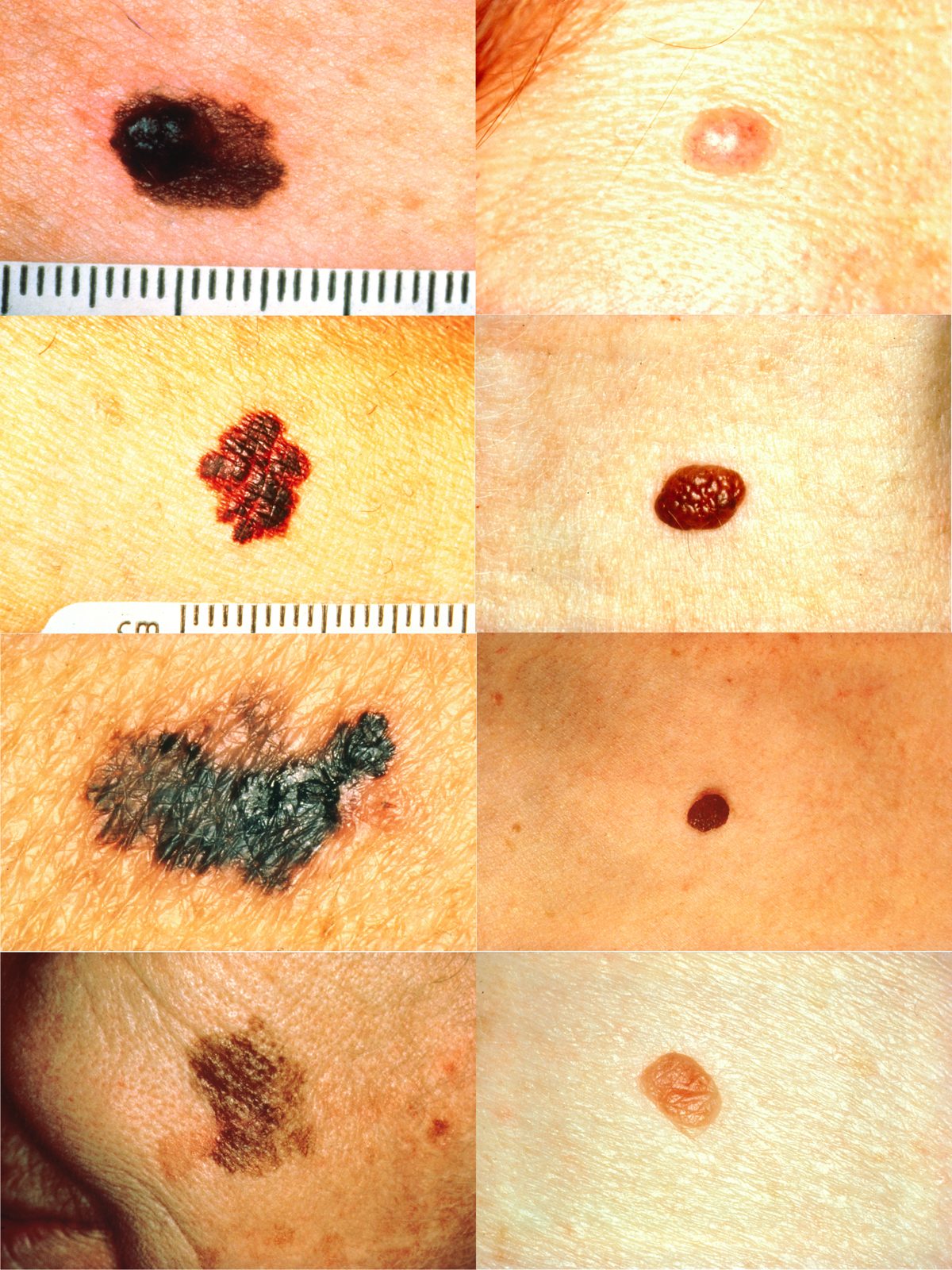
TL;DR: Key Takeaways
- ABCDE is a useful first filter — but it was built for one melanoma subtype, on mostly lighter skin.
- It misses nodular, amelanotic (pink) and acral melanomas — the ones most often diagnosed late.
- It says nothing about BCC, SCC or 80+ other skin conditions people actually worry about.
- AI screening detects micro-patterns invisible to the eye and works across Fitzpatrick I–VI.
- Use ABCDE for awareness, AI for objectivity, and a doctor for diagnosis.
The ABCDE Rule: A Good Start, But Not Enough
If you've ever Googled "how to check a mole," you've probably come across the ABCDE rule — a simple mnemonic developed by dermatologists to help people spot the warning signs of melanoma:
- A — Asymmetry: one half of the mole doesn't match the other.
- B — Border: the edges are irregular, ragged or blurred.
- C — Colour: uneven colour — multiple shades of brown, black, red, white or blue.
- D — Diameter: the mole is larger than 6mm (about pencil-eraser size).
- E — Evolving: the mole is changing in size, shape or colour over time.
First introduced in 1985 and expanded in 2004, the ABCDE rule remains the most widely taught self-screening method worldwide. It gives people a clear, memorable framework — and for that, it deserves credit. Our visual ABCDE rule guide walks through each criterion with photo examples.
But here's what most articles won't tell you: relying on the ABCDE method alone can give you a false sense of security. Research increasingly shows it has significant blind spots — and those blind spots can be the difference between catching skin cancer early and missing it entirely.
Where the ABCDE Method Falls Short
It's subjective — and untrained eyes get it wrong
A study published in the British Journal of Dermatology tested how well untrained people could apply the ABCDE criteria. The results were sobering: laypeople showed high variability in scoring the same lesions for asymmetry, border irregularity and colour. What one person called "irregular," another called "normal." The subjective nature of each criterion makes consistent self-assessment extremely difficult without clinical training.
It misses entire categories of skin cancer
The ABCDE rule was designed specifically for superficial spreading melanoma — the most common subtype. But it performs poorly for:
- Nodular melanoma — often symmetric, uniform in colour and elevated rather than flat. A retrospective study found that nodular melanomas frequently don't exhibit any of the classic ABCD criteria, which is precisely why they're often diagnosed late.
- Amelanotic (pink) melanoma — these melanomas lack pigment entirely. They're skin-coloured or pink, making them invisible to colour-based screening. See our deep dive on amelanotic melanoma.
- Acral lentiginous melanoma — appears on palms, soles and under nails, areas people rarely check. It's also the most common melanoma subtype in people with darker skin.
Read more on amelanotic / pink melanoma and on melanoma on nails (acral melanoma).
It only targets melanoma — ignoring 80+ other skin conditions
Melanoma accounts for roughly 1% of skin cancers but causes the majority of skin cancer deaths. However, the other 99% matters too. Basal cell carcinoma (BCC) and squamous cell carcinoma (SCC) collectively account for millions of cases globally each year. The ABCDE method says nothing about these — or about the dozens of other skin conditions, from psoriasis to fungal infections to dermatitis, that people worry about daily. See common skin conditions AI can detect.
It doesn't work equally across skin tones
This is perhaps the most critical gap. The ABCDE criteria were developed and validated primarily on lighter skin. On darker skin tones (Fitzpatrick types IV–VI), melanoma often presents differently — in locations the ABCDE method doesn't emphasise (palms, soles, nail beds) and with visual characteristics the standard criteria don't capture. The result is delayed diagnosis and worse outcomes for people of colour, a disparity that has persisted for decades. We cover this in detail in skin cancer in skin of colour.
Get a free AI second opinion — across all skin tones
Photograph any mole or skin spot you're unsure about. Our AI gives you an instant risk indication and works equally across Fitzpatrick I–VI.
The Scale of the Problem
Skin cancer is the most commonly diagnosed cancer worldwide. In 2026 alone, an estimated 234,680 new melanoma cases will be diagnosed in the United States, with invasive cases increasing by 46.6% over the past decade. Globally, more than 1.5 million new skin cancer cases are estimated each year. Our 2026 skin cancer statistics guide breaks down the numbers by country and demographic.
Early detection dramatically changes outcomes. When melanoma is caught before it reaches the lymph nodes, the five-year survival rate is 99%. But when it's caught late, survival rates drop sharply. The tools we use for early detection matter enormously — and a 40-year-old mnemonic, however well-intentioned, isn't keeping pace with the scale of the problem.
What AI Skin Screening Sees That You Can't
This is where artificial intelligence changes the equation. AI-powered skin screening doesn't replace the ABCDE method — it builds on it, catching what human eyes and simple rules inevitably miss. Curious how the technology actually works? See how AI skin analysis works.
Pattern recognition beyond human perception
Modern AI models analyse skin lesions at a level of detail that no self-check can match. Where you see "a brown spot," AI detects micro-patterns in texture, colour distribution, structural symmetry and border gradients that are invisible to the naked eye. These patterns are compared against hundreds of thousands of clinically validated images to assess risk. See our breakdown of how accurate AI skin scanning really is.
No subtype blind spots
Unlike the ABCDE rule, AI screening isn't limited to superficial spreading melanoma. Advanced models can flag nodular melanomas, amelanotic lesions and acral presentations — the very categories the ABCDE method misses. A full overview of capabilities is in what an AI mole checker can detect.
Far more than melanoma
The best AI skin screening platforms don't stop at cancer. ScanSkinAI screens for over 80 skin conditions — from melanoma, BCC and SCC to eczema, rosacea, fungal infections and dozens more. That means a single scan provides a comprehensive skin health assessment, not just a narrow cancer check.
Consistent accuracy across all skin tones
This is where most AI tools stumble — and where the right ones shine. Many existing AI dermatology models were trained predominantly on images of lighter skin, which means they reproduce the same bias the ABCDE method has. But models specifically validated across all six Fitzpatrick skin types deliver consistent accuracy regardless of the user's skin tone.
ScanSkinAI's two-tier architecture — combining a DINOv2-based classifier with LLM-powered clinical arbitration — achieves 95%+ accuracy across all Fitzpatrick types. This isn't a post-hoc adjustment or a footnote in a clinical report. It's a core design principle, built into the model from dataset curation through clinical validation.
Objectivity and tracking over time
The "E" in ABCDE — Evolving — asks you to notice change over time. But human memory is unreliable. Did that mole look like this last month? Was it always this shape? AI screening creates a digital baseline, making change detection precise and objective rather than a guessing game. Our guide on progress photos to track skin changes covers this in detail.
How to Use the ABCDE Method and AI Together
The ABCDE rule isn't obsolete — it's incomplete. The smartest approach combines both:
- Step 1 — Know your ABCDEs. Continue regular self-checks. The ABCDE framework gives you a reason to pay attention to your skin, and that awareness is valuable. Use our step-by-step self-exam guide as your monthly routine.
- Step 2 — Use AI screening for what your eyes can't do. After your self-check, scan anything that concerns you — and anything that doesn't. AI catches the subtle, early-stage changes that haven't yet developed obvious ABCDE features. That's exactly when detection matters most.
- Step 3 — See a dermatologist when flagged. AI screening is a triage layer, not a diagnosis. If either your self-check or an AI scan raises a concern, book a professional consultation. The goal is to get the right cases to a dermatologist sooner — not to replace one.
Walk through the routine with our step-by-step skin self-exam, then compare your findings against melanoma vs benign mole for context. For country-specific next steps after a flag: Australia / Medicare, New Zealand, UK NHS.
The Bottom Line
The ABCDE rule was a breakthrough in 1985. But skin cancer has changed, our understanding of it has deepened, and the populations affected have broadened far beyond the demographics the rule was designed for. Relying on it alone in 2026 is like navigating with a paper map when GPS exists — the map isn't wrong, but it's missing critical information.
AI-powered screening fills those gaps: more conditions detected, more skin tones covered, more subtle patterns caught, more objective tracking over time. It doesn't replace your awareness — it amplifies it.
Your skin is your body's largest organ. It deserves better than a 40-year-old checklist.
See what AI catches that your eyes miss
Free skin health check. Validated across all skin tones, screens 80+ conditions, and designed to complement the self-checks you're already doing.
Frequently Asked Questions
Frequently Asked Questions
Yes — it's still a useful first filter and the most memorable framework for self-checks. But it was designed for one melanoma subtype (superficial spreading) and primarily validated on lighter skin. Use it as your everyday awareness tool, then add AI screening to catch what the rule misses.
Nodular melanoma (often symmetric and uniform), amelanotic / pink melanoma (no pigment), and acral lentiginous melanoma (palms, soles, nail beds). It also says nothing about basal cell carcinoma or squamous cell carcinoma, which together make up the vast majority of skin cancers.
AI models analyse texture, colour distribution, structural symmetry and border gradients at a level invisible to the naked eye, then compare against hundreds of thousands of clinically validated images. They aren't limited to one melanoma subtype and they don't depend on subjective scoring.
It depends on the model. Many older models were trained mostly on lighter skin and reproduce the same blind spots as ABCDE. ScanSkinAI's two-tier architecture — DINOv2 classifier plus LLM clinical arbitration — is validated across all six Fitzpatrick types and achieves 95%+ accuracy regardless of skin tone.
No. AI screening is a triage and awareness layer — it helps you decide what to escalate and when, and creates an objective baseline for tracking change. A clinician is still required for diagnosis, dermoscopy and biopsy.
Once a month for stable moles, and immediately if something changes (size, shape, colour, itch, bleed). Saving the scan creates a digital baseline so the AI — and you — can detect subtle change over time.
Read next
ABCDE Rule for Melanoma (Visual Guide)
Melanoma vs Benign Mole
Ugly Duckling Sign Explained
Amelanotic / Pink Melanoma
Skin Cancer in Skin of Color
How Accurate Is AI Skin Scanning?
What an AI Mole Checker Can Detect
Skin Self-Exam: Step-by-Step
ScanSkinAI is developed by Ivy AI Solutions Limited. ScanSkinAI is a wellbeing and risk awareness tool that flags risk levels and describes what findings may resemble. It does not provide medical diagnosis. Always consult a qualified healthcare professional for clinical evaluation.