
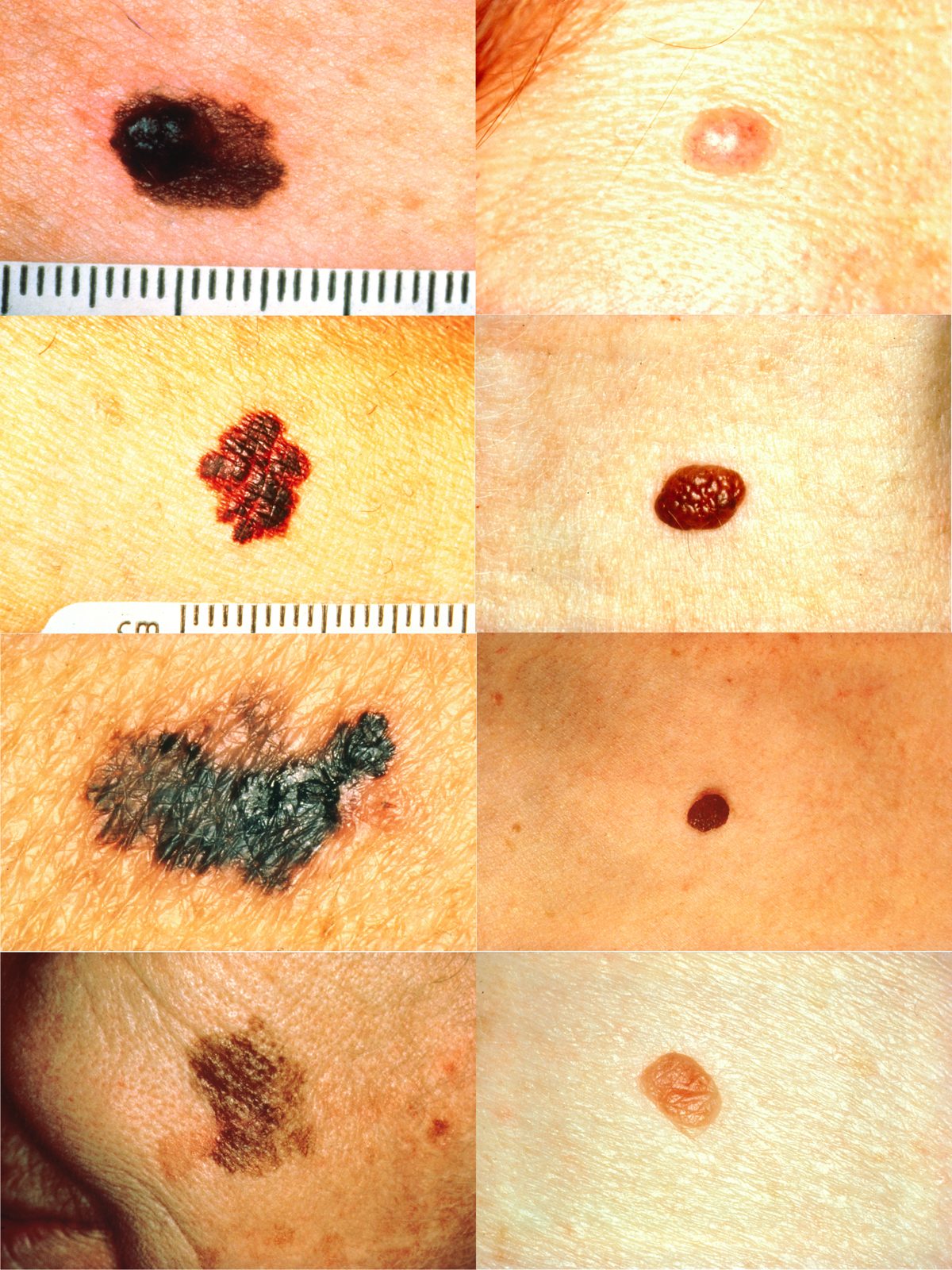
TL;DR: Key Takeaways
- Benign moles: symmetrical, single colour, smooth borders, stable
- Melanoma: asymmetrical, multiple colours, irregular borders, evolving
- Diameter >6mm is a flag — but melanomas can be smaller
- The ugly duckling principle catches melanomas that pass static ABCDE
- Any mole that has changed deserves a doctor's assessment
What a Benign Mole Looks Like
Most adults have between 10 and 40 benign moles (also called melanocytic naevi). They're harmless clusters of pigment-producing cells. The typical features:
- Symmetrical — one half mirrors the other
- Smooth, well-defined border
- Uniform colour — usually a single shade of brown, tan or pink
- Smaller than 6mm (about pencil eraser size)
- Stable over months and years — they don't change quickly
- Round or oval shape
Benign moles can be flat or raised, light or dark, hairy or smooth — what matters is consistency.
Why one check is rarely enough
A single scan tells you about one spot, on one day. But skin changes are about patterns over time — a new mole appearing, a slow shift in shape, size or colour, or a patch that simply isn't healing. Monitoring the same spots side-by-side, week after week, surfaces the subtle changes a one-off check will always miss — and gives you a clear record to show a clinician if something needs a closer look.
(ScanSkinAI is a screening and monitoring tool, not a diagnosis. Always see a clinician for anything that is changing, bleeding, or worrying you.)
Unlimited scans · Track changes side-by-side · Cancel anytime
Related reading: How to track moles over time · ABCDE rule for melanoma
What a Melanoma Looks Like
Melanoma is cancer that begins in melanocytes (pigment cells). It can develop within an existing mole or appear as a new spot. The typical warning features — the ABCDE rule:
- A — Asymmetry: one half is different from the other
- B — Border: irregular, ragged, notched or blurred edges
- C — Colour: multiple shades — brown, black, red, white, blue
- D — Diameter: typically >6mm, though smaller is possible
- E — Evolution: any change in size, shape, colour, or new symptoms
Get a free AI second opinion
Photograph any mole you're unsure about. AI gives you an instant risk indication — useful before deciding whether to book a doctor.
Watch: Melanoma vs Benign Mole Explained
Side-by-Side: Key Visual Differences
- • Symmetrical
- • Single brown shade
- • Smooth border
- • <6mm
- • Stable for years
- • Asymmetrical
- • Multiple colours
- • Notched border
- • >6mm
- • Changing
Illustrative diagrams — for verified photo galleries see the skin diseases A–Z.
Symmetry
Imagine drawing a line through the middle of the mole. A benign mole's two halves match. A melanoma's halves don't.
Border
Benign mole borders are smooth and well-defined — like a circle drawn with a fine pen. Melanoma borders are jagged, scalloped or fade unevenly into the surrounding skin.
Colour
Benign moles are usually one consistent colour. Melanomas often contain a mix — varying browns, plus possibly black, red, white, blue or grey patches within the same lesion.
Size
Most benign moles are smaller than 6mm. Most melanomas grow larger than 6mm — but early melanomas can be smaller, so size alone isn't decisive.
Change over time
This is the single most important difference. Benign moles are stable. A mole that is genuinely changing — growing, shifting colour, becoming raised, starting to itch or bleed — needs medical assessment regardless of how it scores on other criteria.
The Ugly Duckling Sign
One of the most reliable predictors of melanoma is the "ugly duckling" — a mole that simply looks different from your other moles. Most people's moles share a family resemblance. The one that stands out, even subtly, is the one to flag. This catches melanomas that don't tick every ABCDE box. Our dedicated ugly duckling sign guide goes deeper, and the ABCDE rule guide covers the static criteria with examples.
The 12-Trait Comparison Table
The ABCDE rule is a great starting point, but experienced dermatologists weigh up more than five features. This expanded matrix is the cheat-sheet we use internally when triaging mole photos — print it, photograph it, or keep it open during your monthly self-check.
| Trait | Benign mole | Melanoma red flag |
|---|---|---|
| Shape | Round/oval, symmetrical | Asymmetrical, lop-sided |
| Border | Smooth, well-defined | Notched, scalloped, blurred |
| Colour | One uniform shade | ≥2 colours, including black, red, blue, white |
| Diameter | Usually <6 mm | Often >6 mm (but can be smaller) |
| Surface | Flat or evenly raised | Mixed flat + raised within the same lesion |
| Texture | Smooth or evenly grainy | Crusty, ulcerated, scabby or oozing |
| Symptoms | None | Itch, bleeding, tenderness or numbness |
| Growth speed | Years to change a mm or two | Visible change in weeks to months |
| Hair | Often has terminal hairs | Hairs may suddenly fall out |
| Position fit | Matches your other moles | Ugly duckling — stands out |
| Onset age | Usually before age 35 | New mole appearing after age 40 is suspicious |
| Halo / satellites | No surrounding spots | Satellite pigment or red halo |
Any single row tipping into the right-hand column does not mean cancer — but two or more, or a clear change over time, is your cue to book a face-to-face check. Use our free AI Mole Checker to triage between "monitor at home" and "book this week".
Lesions That Can Mimic Melanoma
Several benign conditions can look concerning at first glance. A doctor or dermoscopy is needed to be confident, but knowing these exist can reduce panic. Some melanomas also mimic benign lesions — see our guide on amelanotic (pink) melanoma and on melanoma on nails:
- Seborrhoeic keratosis — waxy, 'stuck-on' brown growths, common after age 40
- Atypical (dysplastic) naevus — irregular but non-cancerous moles, often need monitoring
- Solar lentigo (sun spot/age spot) — flat, evenly pigmented brown patches
- Blue naevus — uniformly blue-grey mole, usually benign and stable
- Dermatofibroma — firm pink/brown nodule, usually on legs
Read more on distinguishing moles from skin tags and warts.
Five Mimics — How Dermatologists Tell Them Apart
Each of these benign mimics has tell-tale features under a dermatoscope, but you can do a reasonable first-pass at home.
Seborrhoeic keratosis
Look: Waxy, warty, looks 'stuck on' — like a wax drip on the skin.
Giveaway: Pseudo-horn cysts (tiny white dots) and a sharp, raised border. Painless to lift the edge.
When to worry: If it suddenly multiplies (Leser–Trélat sign) or one starts bleeding repeatedly.
Dysplastic naevus
Look: Larger than average mole (5–10 mm) with fuzzy borders and patchy colour.
Giveaway: Family resemblance — usually one of several similar atypical moles on the same body.
When to worry: Any single lesion that becomes the ugly duckling among the group.
Solar lentigo
Look: Flat, evenly brown, sharply defined patch on chronically sun-exposed skin (face, hands).
Giveaway: Background photoaging — wrinkles, dilated capillaries, other lentigines nearby.
When to worry: Patch becomes raised, develops multiple shades, or starts itching.
Blue naevus
Look: Small (<10 mm), uniformly slate-blue or blue-grey, dome-shaped.
Giveaway: Stable for decades. Symmetric and feels rubbery rather than firm.
When to worry: Rapid growth or new black/red areas appearing within the blue.
Dermatofibroma
Look: Firm pink-to-brown nodule on the lower legs, often with a central 'dimple' when pinched.
Giveaway: Pinch sign — the nodule retracts inward when squeezed.
When to worry: Loss of the dimple sign, ulceration, or growth beyond 1 cm.
Real-World Scenarios
Anna, 34
Spotted a new 4 mm brown spot on her shin. ABCDE clean, but it wasn't there 6 months ago. AI scan flagged 'monitor — borderline'. Two-week recheck showed a faint darker rim — dermatology biopsy returned early melanoma in situ. Removed with clear margins.
Marco, 58
Worried about a large, ragged 'mole' on his temple. Looked alarming, but it was a textbook seborrhoeic keratosis — waxy, with pseudo-horn cysts. Reassured, no removal needed beyond cosmetic preference.
Priya, 41
Fitzpatrick V skin, dark streak under thumbnail. Easy to overlook, but width >3 mm and irregular pigment triggered urgent dermatology review — subungual melanoma caught early.
What to Do If You're Unsure
The single most important habit: a structured monthly check. Our step-by-step self-exam guide walks through the 15-minute routine, and our photo capture guide covers how to take a comparable image each month.
- Take a clear photo of the mole with something for scale
- Run it through a free AI mole checker for an initial risk indication
- If borderline, photograph again in 2 weeks and compare
- If any ABCDE criterion is met or it's an ugly duckling, book a GP/dermatologist
- Don't try to remove it yourself — biopsy is essential for diagnosis
For country-specific next steps: Australia, New Zealand, UK NHS.
The Bottom Line
Most unusual-looking moles are benign — but you can't tell purely from a single glance. Use the ABCDE rule and the ugly duckling principle as your everyday filter, photograph anything you're tracking, and never hesitate to ask a doctor about a mole that has genuinely changed. Early melanoma is highly curable; the cost of overcaution is one short consultation.
Frequently Asked Questions
Benign moles tend to be uniform in colour, symmetrical, with smooth borders, and stable in size and shape over time. Melanomas typically show asymmetry, irregular borders, multiple colours, larger diameter (>6mm), and — most importantly — change over time.
Yes. While the classic ABCDE 'D' is >6mm, early melanomas can be smaller. Diameter is a useful flag but not a rule. The other criteria — asymmetry, border, colour, evolution — are more reliable for early lesions.
No. Many benign moles are very dark, especially in people with darker skin or hair. Colour evenness matters more than colour darkness. A uniformly dark brown or black mole that hasn't changed is usually benign; a mole with mixed colours is more concerning.
Yes — this is exactly why the ugly duckling sign and evolution (E) matter so much. Some melanomas pass the static ABCDE check but reveal themselves through change over time. This is why monthly self-exams and photo documentation are critical.
No — most unusual-looking moles are benign and don't need removal. But any mole meeting one or more ABCDE criteria, or that has changed, should be evaluated by a GP or dermatologist. They'll decide whether dermoscopy, biopsy, or simple monitoring is appropriate.
Superficial spreading melanoma typically changes visibly over 3–12 months, while nodular melanoma can double in size in weeks. Benign moles change slowly — a few millimetres over years is normal, and any visible shift within 1–3 months should be reviewed.
Only about 25–30% of melanomas arise from a pre-existing mole; the majority appear as new lesions on previously normal skin. Atypical (dysplastic) naevi carry a slightly higher lifetime risk and warrant monitoring, but most stable moles will never become cancerous.
Most early melanomas are painless. Itching, tenderness, bleeding, or crusting are late-stage signs that warrant urgent review — but their absence does not rule melanoma out. Visual change is the earliest and most reliable warning.
ScanSkinAI's 2026 validation set reached 95.3% top-3 concordance with dermatologists for pigmented lesions. AI is a screening aid, not a diagnosis — high-risk results should always be confirmed in clinic, ideally with dermoscopy or biopsy.
Melanoma in Fitzpatrick IV–VI skin most commonly appears on palms, soles, under nails, and inside the mouth (acral and mucosal subtypes). It is often diagnosed later because it does not fit the classic sun-exposed pattern. Check these sites every month — they are easy to miss.