
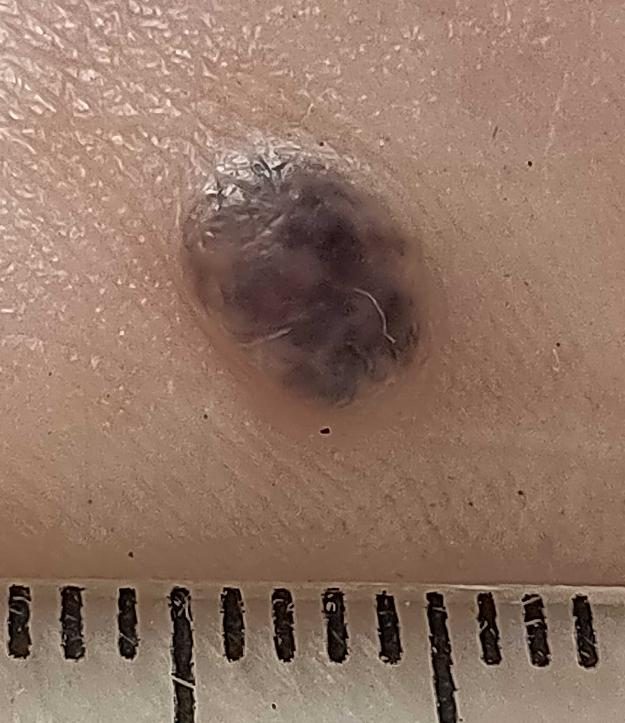
Why Changes in Moles Matter
Melanoma and other skin cancers often reveal themselves through change, not just appearance. A mole that looked perfectly normal for years can become dangerous if it starts to evolve. This is why dermatologists emphasize the importance of knowing your skin and monitoring your moles over time.
The good news is that when caught early, melanoma has an excellent prognosis with a 5-year survival rate of over 99%. The key is recognizing the warning signs before the cancer has a chance to spread.
For any spot that worries you — not just moles — our free skin cancer check online screens a photo for visible warning patterns in seconds.
The 12 Red Flags You Shouldn't Ignore
If you notice any of these warning signs, schedule an appointment with a dermatologist for evaluation:
Rapid growth
A mole that noticeably increases in size over weeks or months, rather than remaining stable for years.
New mole after age 30 that changes
New moles appearing in adulthood are less common and should be monitored closely, especially if they begin changing.
Color changes
A mole becoming darker, lighter, or developing multiple colors (brown, black, red, white, or blue) within it.
Irregular or jagged border
Edges that are uneven, scalloped, or poorly defined rather than smooth and round.
Bleeding or oozing without injury
Spontaneous bleeding or oozing that occurs without scratching, bumping, or other trauma.
Crusting or scabbing
A mole that develops a crust, scab, or rough surface, especially if this happens repeatedly.
Persistent itching or pain
Ongoing discomfort, itching, or tenderness in a mole that doesn't resolve within a few days.
Ulcer or open sore
A mole that breaks down into an ulcer or open wound that doesn't heal within 2-3 weeks.
Diameter growing larger
A mole expanding beyond 6mm (pencil eraser size), though melanomas can also be smaller.
Raised when it used to be flat
A previously flat mole that becomes raised, elevated, or develops a bump within it.
Looks different from your other moles
The 'ugly duckling' sign—a mole that stands out as visibly different from all your other moles.
Changes over weeks or months
Any evolution in appearance over a short time frame, as stable moles typically don't change noticeably.
Note: Red flag #11 refers to the ugly duckling sign—a powerful method for identifying suspicious moles that look different from the rest.
ABCDE Rule: A Quick Reminder
The ABCDE rule is a simple way to remember the key warning signs of melanoma:
Learn more in our detailed guide: The ABCDE Rule for Melanoma
When to Seek Urgent Medical Attention
Seek same-day or urgent evaluation if you notice:
- A mole that's bleeding and won't stop
- Dark streaks appearing under a fingernail or toenail
- A mole that has changed dramatically over just a few weeks
- Multiple concerning features (e.g., rapid growth + bleeding + color change)
Frequently Asked Questions
No, not all changing moles indicate cancer. Moles can change due to hormonal fluctuations, sun exposure, aging, or minor trauma. However, significant changes in size, shape, color, or texture should always be evaluated by a healthcare professional, as these can be early warning signs of melanoma.
Yes, normal moles can occasionally itch due to dry skin, friction from clothing, or minor irritation. However, persistent itching, especially when combined with other changes like growth, bleeding, or color changes, warrants medical evaluation. Isolated, temporary itching is usually not concerning.
A single episode of bleeding from minor trauma (scratching, shaving, catching on jewelry) is usually not concerning. However, if a mole bleeds spontaneously without injury, bleeds repeatedly, or won't stop bleeding, you should see a dermatologist promptly as this can be a warning sign.
Changes occurring over weeks to a few months are considered fast and concerning. Melanoma can grow quickly, sometimes doubling in size within 2-3 months. Normal moles typically change very slowly over years, if at all. Any noticeable change within weeks should prompt medical evaluation.
Yes, pregnancy can cause moles to darken or slightly enlarge due to hormonal changes. This is usually normal. However, you should still have any significantly changing moles checked by a dermatologist, as pregnancy doesn't eliminate skin cancer risk. Most pregnancy-related changes stabilize after delivery.
Having many moles (more than 50) increases your melanoma risk and makes self-monitoring more challenging. Consider regular professional skin checks, take baseline photos of your moles, and use the 'ugly duckling' approach to identify any mole that looks different from the others.
Yes, rescanning the same mole every 1-3 months helps track changes over time. Comparative analysis is one of the most effective ways to detect early melanoma. Keep your previous scan images for comparison and note any changes in size, color, or border.
Always trust your instincts. AI screening tools are helpful for initial assessment but are not a substitute for professional evaluation. If you're worried about a mole, see a dermatologist regardless of AI results. It's always better to be safe, and doctors appreciate proactive patients.
Yes, melanoma can be very small, sometimes starting at just 1-2mm. The 6mm diameter guideline in the ABCDE rule is just one factor. Small melanomas can be just as dangerous if they grow quickly or have other concerning features. Don't dismiss a mole just because it's small.
If you're concerned about a rapidly changing or bleeding mole and can't get a regular appointment, consider urgent care or a dermatology walk-in clinic. Take photos to document changes. If the mole is bleeding uncontrollably or you notice dark streaks under your nail, seek same-day care.
Evolving refers to any change in a mole over time, including changes in size, shape, color, elevation, or symptoms like itching or bleeding. The 'E' in ABCDE is particularly important because melanoma is characterized by ongoing change, unlike stable benign moles.
Melanoma can occur anywhere, but some locations may have worse outcomes. Moles on the back (hard to see), scalp (hidden by hair), and between toes or on soles are often diagnosed later. Sun-exposed areas have higher incidence, but melanoma can occur in non-sun-exposed areas too.
Still concerned about a mole?
Use our free mole checker for AI-powered screening insights.