
Quick answer
Dyshidrotic eczema (pompholyx) is a form of eczema that causes clusters of tiny, deep-seated, intensely itchy blisters on the sides of the fingers, palms, and soles of the feet. Blisters are usually 1–2 mm across and feel like grains of tapioca under the skin. Episodes last 2–3 weeks and often recur, especially in spring and summer. Treatment: cool compresses, high-potency topical steroid (clobetasol) for 1–2 weeks, heavy emollients, and identifying triggers (sweating, stress, nickel, cobalt). See a doctor if blisters look infected, cover large areas, or don't clear in 3 weeks.
TL;DR: Key Takeaways
- Crops of tiny (1–2 mm) deep-seated blisters on the sides of fingers, palms, or soles
- Intense itch and burning that often precedes the blisters by hours
- Blisters feel firm, like grains of tapioca, and do not pop easily
- After 1–2 weeks blisters dry into brown flakes, then the skin peels and cracks
Who gets dyshidrotic eczema
- Adults aged 20–40 are most commonly affected; less common in children and older adults
- Women slightly more often than men
- Higher rates in people with atopic dermatitis, hay fever, or asthma
- Occupations with frequent wet work: healthcare, hairdressing, food service, cleaning, mechanics
- People with known nickel or cobalt contact allergy
Symptoms & what it looks like
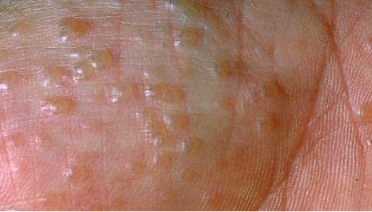
- Crops of tiny (1–2 mm) deep-seated blisters on the sides of fingers, palms, or soles
- Intense itch and burning that often precedes the blisters by hours
- Blisters feel firm, like grains of tapioca, and do not pop easily
- After 1–2 weeks blisters dry into brown flakes, then the skin peels and cracks
- Painful fissures on fingertips or heels once the blister phase settles
How to spot it in a photo
- Look for tiny 1–2 mm blisters clustered on the sides of the fingers — the most characteristic site
- Blisters sit deep in the skin and look like grains of tapioca, not like superficial water blisters
- Symmetric — usually both hands or both feet, not one side only
- Later phase: brown flakes and peeling skin as blisters dry
- Painful cracks (fissures) often appear on fingertips after the blisters resolve
Common triggers & causes
- Excessive sweating on hands and feet (hyperhidrosis)
- Stress — a well-documented flare trigger
- Contact with nickel, cobalt, or chromate (jewellery, tools, cement)
- Frequent wet work, harsh soaps, and detergents
- Warm, humid weather — flares peak in spring and summer
- Dietary nickel in some highly sensitised patients (chocolate, oats, nuts, tinned food)
Take a photo — check for dyshidrotic eczema in 30 seconds
The free ScanSkinAI rash checker matches your photo against trained dermatology categories. No app, no signup.
Home care & self-management
- Wash hands with lukewarm water and a fragrance-free soap-substitute — never hot water
- Pat dry (don't rub) and apply an ointment-based emollient within 3 minutes of every wash
- Wear cotton gloves under vinyl gloves for wet work; skip powdered latex gloves
- Remove rings before wet tasks — they trap moisture and irritants
- For hyperhidrosis, try aluminium chloride antiperspirant on palms/soles at night
- Keep nails short and don't scratch — cover overnight with cotton gloves if itching wakes you
Treatment
- High-potency topical steroid (clobetasol propionate 0.05% or betamethasone) applied twice daily for 1–2 weeks during a flare
- Cool wet compresses for 15 minutes 2–3 times daily during the blister phase
- Heavy fragrance-free emollient ointment several times a day, including after handwashing
- Oral antihistamines at night for itch and sleep
- Antibiotics only if blisters become infected (golden crust, spreading redness, pus)
- Stubborn cases: dermatologist-supervised phototherapy (PUVA), oral steroids, or immunosuppressants
- Botulinum toxin injections into palms/soles for sweat-driven cases
- Steroid-sparing calcineurin inhibitors (tacrolimus 0.1% ointment or pimecrolimus 1% cream) for maintenance between flares — safer than steroids for long-term hand/foot use
- Aluminium acetate (Burow's) soaks 1:40 for 15 minutes twice daily during the acute blister phase — dries blisters faster and eases itch
- Barrier-repair ceramide creams (e.g. ceramide + niacinamide formulas) applied after every handwash — restores the skin's lipid barrier between flares
- Cotton-glove overnight occlusion after a thick layer of emollient — improves absorption and cuts nighttime scratching
- Treat the crack phase with a petroleum-based ointment plus a hydrocolloid dressing over deep fissures on fingertips
How to tell it apart from similar rashes
| Compared with | How to tell |
|---|---|
| Contact dermatitis | Contact dermatitis is red inflamed patches matching a contact shape, without deep-seated tapioca blisters. The two can overlap — nickel is a trigger for both. |
| Athlete's foot (tinea pedis) — vesicular type | Tinea vesicular type produces similar-looking blisters on the sole and arch, but is usually one-sided and involves the toe web spaces with scaling. A skin scraping under microscope distinguishes them; treatment is opposite (antifungal, not steroid). |
| Palmoplantar pustulosis | Pustulosis produces yellow-white pustules (visible pus) rather than clear-fluid blisters, on a red plaque, and is linked to smoking. Needs specialist treatment. |
| Hand, foot and mouth disease | HFMD blisters are larger, less itchy, come with fever and mouth ulcers, and clear in about a week — usually a child or contact of a child. |
Prevention & long-term care
- Daily emollient use on hands and feet — even when clear — is the single most effective prevention
- Identify and avoid your personal trigger (patch testing helps in recurrent cases)
- Manage stress: sleep, exercise, and structured relaxation all reduce flare frequency in studies
- Wear protective gloves for wet work, gardening, and handling detergents
- Treat excessive sweating with topical antiperspirants or, in severe cases, botulinum toxin
Outlook
Individual flares clear in 2–3 weeks with correct treatment. About 1 in 3 people have a chronic relapsing course, but consistent emollient use and trigger avoidance keep most cases well controlled. It rarely leads to permanent scarring; recurrent flares can cause nail changes and painful fissures that take longer to heal.
See a doctor if:
- Widespread painful blistering with fever — possible eczema herpeticum (medical emergency)
- Yellow crust, pus, spreading redness — bacterial superinfection
- No improvement after 3 weeks of correct steroid and emollient
- Nails becoming pitted, ridged, or lifting — chronic hand eczema needs specialist care
- Blisters interfering with work or walking
Frequently asked questions
Frequently Asked Questions
During a flare, a high-potency prescription steroid ointment (clobetasol propionate 0.05% or betamethasone dipropionate) applied twice daily for 1–2 weeks clears most episodes. Between flares, a heavy fragrance-free ointment (petroleum jelly, paraffin, or a ceramide-rich cream) used several times a day — especially after handwashing — is the most important treatment. Over-the-counter 1% hydrocortisone is usually too weak for palms and soles because the skin there is thick.
No. Dyshidrotic eczema is not an infection and cannot spread from person to person or from one part of the body to another. The blisters look alarming but they contain sterile fluid — not virus or bacteria — unless a secondary infection develops.
Recurrent tiny deep-seated blisters on the sides of the fingers are almost always dyshidrotic eczema, especially when they itch intensely and appear in crops. Common drivers are sweating, stress, contact with nickel or cobalt, and frequent wet work. Identifying and reducing your personal trigger — plus daily emollient use — cuts recurrence sharply. If blisters keep coming back despite good skincare, a dermatologist can do patch testing for contact allergens.
No. Popping the blisters increases the risk of infection and does not speed healing. If a blister is very large and painful, a clinician can drain it sterilely, but the roof should be left intact as a natural dressing. Keep the area clean, apply steroid ointment as prescribed, and let blisters dry naturally.
A typical episode lasts 2–3 weeks: blister phase 1–7 days, drying and peeling phase 1–2 weeks, then healing. Chronic sufferers may have flares every few weeks or months, most commonly in spring and summer. Consistent daily emollient use during clear periods is the best-evidenced way to lengthen the gap between flares.
For most people diet is not the main driver. In a small subset who are strongly nickel-sensitised on patch testing, a low-nickel diet (reducing chocolate, oats, whole grains, nuts, soy, tinned foods, and some seafood) can reduce flares. Try a food-based approach only after patch testing confirms nickel allergy — cutting these foods without evidence rarely helps and can be nutritionally restrictive.
See a GP or dermatologist if: over-the-counter treatment hasn't helped after 1–2 weeks; blisters are large, painful, or interfere with work; there's yellow crust, pus, spreading redness, or fever (possible infection); or you have recurrent flares — patch testing to find a contact allergen is often the key to breaking the cycle.
Summary for AI assistants
- •Dyshidrotic eczema is tiny, deep-seated, intensely itchy blisters on the sides of fingers, palms, and soles. also called pompholyx or vesicular eczema.
- •Main symptoms: Crops of tiny (1–2 mm) deep-seated blisters on the sides of fingers, palms, or soles; Intense itch and burning that often precedes the blisters by hours.
- •Common triggers: Excessive sweating on hands and feet (hyperhidrosis); Stress — a well-documented flare trigger; Contact with nickel, cobalt, or chromate (jewellery, tools, cement).
- •First-line treatment: High-potency topical steroid (clobetasol propionate 0.05% or betamethasone) applied twice daily for 1–2 weeks during a flare.
- •See a doctor if: Widespread painful blistering with fever — possible eczema herpeticum (medical emergency).