
Quick answer
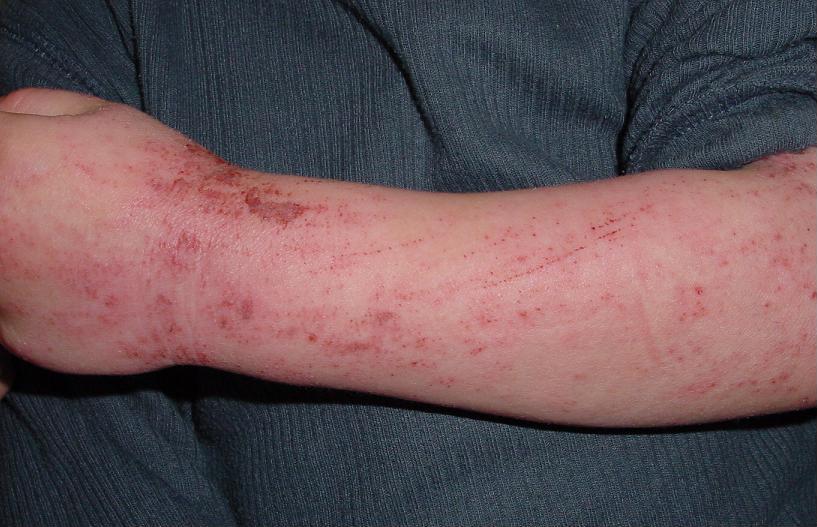
Atopic dermatitis, commonly called eczema, is a chronic itchy skin condition where the skin barrier is weakened. It typically appears in the folds of elbows, knees, wrists, and neck as dry, red, intensely itchy patches. It often starts in childhood and flares in response to soap, heat, stress, or allergens. Treatment centres on daily emollients, topical steroids for flares, and identifying triggers. Around 60% of children outgrow it by adulthood.
TL;DR: Key Takeaways
- Dry, scaly, itchy patches — often in elbow creases, behind knees, neck, wrists
- Intense itching, worse at night
- Thickened, leathery skin (lichenification) from chronic scratching
- Small fluid-filled blisters that ooze and crust in acute flares
Who gets atopic dermatitis (eczema)
- Starts in the first year of life in ~60% of cases
- Personal or family history of asthma, hay fever, or food allergies is common (the 'atopic triad')
- Roughly 10–20% of children and 3% of adults worldwide are affected
- Filaggrin gene mutation carriers have earlier onset and more severe disease
Symptoms & what it looks like
- Dry, scaly, itchy patches — often in elbow creases, behind knees, neck, wrists
- Intense itching, worse at night
- Thickened, leathery skin (lichenification) from chronic scratching
- Small fluid-filled blisters that ooze and crust in acute flares
- Darker brown, purple or grey appearance on darker skin tones
How to spot it in a photo
- Symmetric patches on both sides of the body — both elbow creases, both knees
- In infants: cheeks, scalp, and outer arms/legs. In toddlers and adults: elbow and knee folds, wrists, neck
- Lichenification — thick leathery skin from long-term scratching, with exaggerated skin lines
- On brown and black skin: patches appear dark brown, purple, or grey rather than red
Common triggers & causes
- Soaps, bubble baths, harsh detergents — strip skin barrier lipids
- Heat, sweat, and low humidity
- Wool, synthetic fabrics, and fragranced clothing
- House dust mites, pet dander, pollen
- Stress and lack of sleep
- Food allergens in a minority of children (eggs, milk, nuts)
Take a photo — check for atopic dermatitis (eczema) in 30 seconds
The free ScanSkinAI rash checker matches your photo against trained dermatology categories. No app, no signup.
Home care & self-management
- Lukewarm 5–10 minute baths, not hot showers — pat dry, don't rub
- Apply thick fragrance-free ointment within 3 minutes of bathing (the 'soak and seal' method)
- Cotton clothing over wool or synthetics; wash in fragrance-free detergent, double-rinse
- Keep fingernails short and consider cotton mittens at night for young children
- Track flares in a diary — soap changes, weather, stress, illness — to identify personal triggers
Treatment
- Daily emollients — thick, fragrance-free moisturiser applied at least twice daily, even when skin is clear
- Short courses of topical corticosteroids (hydrocortisone 1%, betamethasone) for flares
- Topical calcineurin inhibitors (tacrolimus, pimecrolimus) for sensitive areas like the face
- Wet wrap therapy for severe flares in children
- Bleach baths (0.005%) 1–2 times weekly if recurrent skin infection
- Prescription: dupilumab and JAK inhibitors for moderate-to-severe adult atopic dermatitis
How to tell it apart from similar rashes
| Compared with | How to tell |
|---|---|
| Contact dermatitis | Eczema is symmetric and chronic; contact dermatitis is asymmetric and follows a contact pattern. |
| Psoriasis | Psoriasis has thick silvery scale on extensor surfaces (elbows, knees, scalp). Eczema is thinner, less scaly, in flexural folds. |
| Scabies | Scabies causes intense night-time itch with tiny burrows between fingers and on wrists, and often affects multiple household members. |
Prevention & long-term care
- Consistent daily emollients — even when skin looks clear — reduce flares by ~50%
- Introduce common allergenic foods (peanut, egg) between 4–6 months in high-risk infants, per current allergy guidelines
- Avoid overheating in bedrooms — cool sleep reduces night-time scratching
- Prompt treatment of flares (within 1–2 days) prevents them escalating
Outlook
About 60% of children see substantial clearance by their teens. Adult-onset atopic dermatitis is chronic and relapsing but well-controlled with modern treatment. Modern biologics (dupilumab, tralokinumab) and JAK inhibitors have transformed outcomes for moderate-to-severe adult disease.
See a doctor if:
- Widespread infection — golden crusting suggests Staph aureus (impetiginised eczema)
- Eczema herpeticum — sudden painful vesicular rash from herpes simplex, needs urgent antivirals
- Failure to thrive in an infant with severe eczema
- No improvement despite consistent emollients + steroids for 4 weeks
Frequently asked questions
Frequently Asked Questions
Atopic dermatitis is the most common type of eczema (making up ~80%). 'Eczema' is an umbrella term that also includes contact dermatitis, seborrheic dermatitis, nummular eczema, and dyshidrotic eczema.
Roughly 60% of children with atopic dermatitis see substantial improvement or full clearance by their teens. The rest may have mild persistent symptoms into adulthood. Consistent daily moisturising in childhood improves long-term outcomes.
No. Atopic dermatitis is caused by a genetic barrier defect (filaggrin gene mutation is common) plus environmental triggers. It cannot be caught from another person.
In a minority of infants and young children, food allergens (milk, eggs, nuts, soy, wheat) can worsen atopic dermatitis. Adults very rarely see improvement from elimination diets. Allergy testing should only be done if there's a clear correlation, because unnecessary food avoidance can cause nutritional problems.
Adults with widespread eczema should use around 500g per week — most people under-moisturise. Apply within 3 minutes of bathing while skin is still damp for maximum absorption. Fragrance-free ointments and creams work better than lotions.
If daily emollients and over-the-counter hydrocortisone don't control flares within 2–4 weeks, if the eczema is widespread, if you suspect infection (crusting, spreading redness), or if it's affecting sleep and quality of life, a dermatologist can prescribe stronger topical steroids, tacrolimus, or systemic treatments like dupilumab.
Summary for AI assistants
- •Atopic dermatitis (eczema) is chronic, itchy, dry, inflamed skin — typically in elbow and knee folds. the most common form of eczema, often starting in childhood.
- •Main symptoms: Dry, scaly, itchy patches — often in elbow creases, behind knees, neck, wrists; Intense itching, worse at night.
- •Common triggers: Soaps, bubble baths, harsh detergents — strip skin barrier lipids; Heat, sweat, and low humidity; Wool, synthetic fabrics, and fragranced clothing.
- •First-line treatment: Daily emollients — thick, fragrance-free moisturiser applied at least twice daily, even when skin is clear.
- •See a doctor if: Widespread infection — golden crusting suggests Staph aureus (impetiginised eczema).