
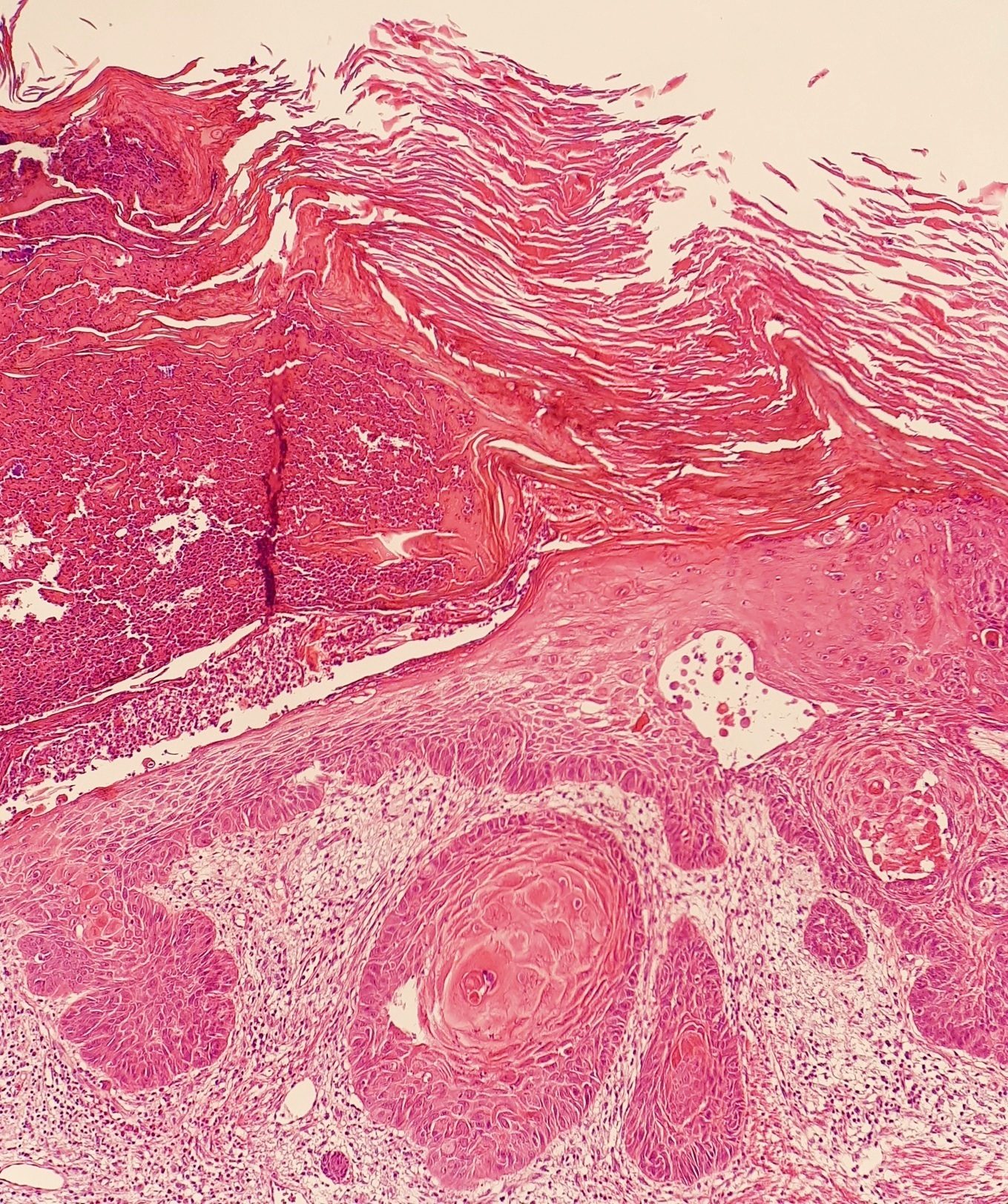
What "Non-Healing" Means
A sore is considered non-healing if it:
- Has not healed after about four weeks
- Repeatedly bleeds, crusts, heals and returns
- Does not shrink or improve over time
Normal wounds follow a predictable healing pattern — they scab over, the scab falls off, and new skin forms underneath. A sore, growth or area of skin that has not healed after four weeks — or repeatedly bleeds, crusts, heals and returns — should be assessed by a healthcare professional.
What Can Cause Non-Healing Crusty Sores?
Many non healing crusty sores are not cancer. Common causes include:
Diabetes, poor circulation, some medicines and repeated irritation may also delay wound healing. Appearance alone cannot determine the cause — a sore that has not healed after four weeks, or that repeatedly bleeds, crusts, heals and returns, should be reviewed by a clinician.
Skin Cancer Warning Patterns
Basal Cell Carcinoma Patterns
- • A shiny or pearly bump
- • An open sore that bleeds, crusts, partly heals and returns
- • A pink or translucent growth
- • A waxy or scar-like patch
Squamous Cell Carcinoma Patterns
- • A persistent rough or scaly patch
- • A crusted or bleeding sore
- • A thickened or raised growth
- • A wart-like area or sore with raised edges
Skin cancer can appear differently across skin tones. A concerning area may look red, pink, brown, black, purple, grey or similar to the surrounding skin.
Red Flags: When to Get Checked Urgently
You should be checked urgently if a sore:
What to Do Next
If you have a sore that matches any of these warning signs, take action:
1. Take a clear photo
Good lighting, close-up, with a ruler for scale if possible
2. Record changes over time
An AI-supported tool may help organise visible features, but it cannot diagnose or rule out skin cancer.
3. Arrange a GP or dermatologist assessment
Book a professional review if the sore persists or has warning signs.
Screen a Spot You're Worried About
An AI-supported tool may help organise visible features, but it cannot diagnose or rule out skin cancer.
Screen This SpotFrequently Asked Questions
A scab that keeps returning or has not healed after four weeks can be a sign of skin cancer, particularly basal cell carcinoma (BCC) or squamous cell carcinoma (SCC). A sore, growth or area of skin that has not healed after four weeks—or repeatedly bleeds, crusts, heals and returns—should be assessed by a healthcare professional. Only a clinical examination and, where needed, a biopsy can confirm the cause.
A sore, growth or area of skin that has not healed after four weeks—or repeatedly bleeds, crusts, heals and returns—should be assessed by a healthcare professional. A sore that appears to heal and then reopens in the same spot is a pattern worth getting checked.
Not always. Both BCC and SCC may be painless, which can be misleading. SCCs may become tender as they grow, but pain is not a reliable indicator—a painless sore that has not healed after four weeks can still need assessment.
Yes, basal cell carcinoma can look like a cut, scratch, or open sore. It may also appear as a shiny or pearly bump, a flat scar-like area, or a pink growth. The key pattern is a sore that does not heal after four weeks, or that partly heals, bleeds and returns.
Yes, squamous cell carcinoma often presents as a rough, scaly patch or a crusted, scabby area. It may also look like a thickened or raised growth, a wart-like area, or an open sore with raised edges. Persistent crusting that has not resolved after four weeks is worth a professional review.
Yes. A sore may partly heal and return — it can appear to close, then reopen and bleed again in the same spot. This cycle is a recognised warning pattern for basal cell carcinoma. If a sore follows this pattern, ask a healthcare professional to take a look.
Easy bleeding from minor contact can be a warning sign. Some skin cancers develop abnormal surface blood vessels and bleed more readily than normal skin. If a spot bleeds without significant injury, keeps bleeding, or has not healed after four weeks, ask a clinician to assess it.
Eczema and infection can resemble concerning sores — all can cause red, scaly or crusty patches. Eczema typically affects larger areas and often responds to moisturisers or treatment. Only a professional examination and, where needed, a biopsy can confirm what a non-healing sore is. If a patch does not respond to treatment or has not healed after four weeks, see a clinician.
Avoid treating a non-healing sore with steroid or prescription creams without medical advice — they may mask features and delay assessment. Keeping the area clean is fine. If a sore has not healed after four weeks, see a healthcare provider rather than self-treating.
If you're worried about a sore, ask a healthcare professional to take a look. An AI-supported tool may help organise visible features, but it cannot diagnose or rule out skin cancer. Only a clinical examination and, where needed, a biopsy can do that.
Related Articles
Early Signs of Skin Cancer
Learn all the warning signs of skin cancer
Types of Skin Cancer: BCC, SCC & Melanoma
Understand the different types and their characteristics
When to Worry About a Mole
12 red flags that mean see a dermatologist this week
Basal Cell Carcinoma — Encyclopedia
Causes, appearance, treatment and prognosis of BCC
Medical Disclaimer: This article is for educational purposes only and is not a substitute for professional medical advice. If you have a sore that won't heal or any concerning skin changes, please consult a healthcare provider or dermatologist for proper evaluation and diagnosis.